
Key Takeaways
- A child is generally considered underweight if their BMI falls below the 2nd centile on the UK-WHO growth charts used by health professionals
- Around 1 in 100 children in England are classified as underweight at Reception age according to the National Child Measurement Programme
- Faltering growth, where a child’s weight drops across two or more centile lines, is a key clinical sign that warrants medical assessment
- Many underweight children simply need energy-dense foods and structured mealtimes rather than junk food or supplements
- Underlying medical causes such as coeliac disease, food allergies or thyroid disorders should always be ruled out by a GP
- Emotional wellbeing matters too: how we talk about weight can shape a child’s body image and relationship with food for life
In This Article
- What Does Underweight Actually Mean for a Child?
- How to Check If Your Child Is Underweight
- Common Causes of Low Weight in Children
- Signs Your Child May Be Underweight
- What to Do If Your Child Is Underweight
- Nutrition Strategies to Help Your Child Gain Weight Healthily
- When to See Your GP or a Specialist
- Supporting Your Child’s Emotional Wellbeing Around Weight
- Underweight vs Naturally Slim: How to Tell the Difference
As a paediatric nutritionist with over fifteen years of experience working across the NHS and private practice, I spend a great deal of time reassuring worried parents. One of the most common concerns I hear is: “Is my child underweight?” It is a question that can cause real anxiety, especially when your child seems smaller than their peers or refuses entire food groups at the dinner table.
The truth is that children come in all shapes and sizes, and being slim is not the same as being underweight. But there are times when low weight does need attention, and knowing the difference is important. In this guide, I will walk you through exactly how to assess your child’s weight, what causes children to be underweight in the UK, and the practical steps you can take to help them thrive.
What Does Underweight Actually Mean for a Child?
In clinical terms, an underweight child in the UK is one whose Body Mass Index (BMI) falls below the 2nd centile on the UK-WHO growth charts. These charts are the standard tool used by GPs, health visitors and paediatricians to track how a child is growing compared to other children of the same age and sex.
It is worth understanding that BMI for children works differently from adult BMI. A child’s BMI is plotted against age-specific and sex-specific centile charts, because what counts as a healthy weight changes dramatically as children grow. A BMI that would be perfectly normal for a seven-year-old might be concerning for a twelve-year-old, which is why we always use growth charts rather than a single number.
According to the National Child Measurement Programme (NCMP), approximately 1% of Reception-age children and around 1.3% of Year 6 children in England are classified as underweight. These figures have remained relatively stable over the past decade, even as overweight and obesity rates have fluctuated. If you have received an NCMP letter and are unsure what it means, I recommend reading our guide on what to do after receiving your child’s NCMP results.
One thing I always stress to parents is that a single measurement is just a snapshot. What matters far more is the pattern over time. A child who has always tracked along the 5th centile is likely perfectly healthy; a child who was on the 50th centile and has dropped to the 9th needs investigation.
How to Check If Your Child Is Underweight
The most reliable way to check whether your child is underweight is to use the NHS BMI healthy weight calculator, which is freely available online. You will need your child’s accurate height, weight, date of birth and sex. For children aged 2 to 18, the calculator will tell you which centile your child falls on.
Here are some practical tips for getting accurate measurements at home:
- Weigh your child in light clothing without shoes, ideally first thing in the morning
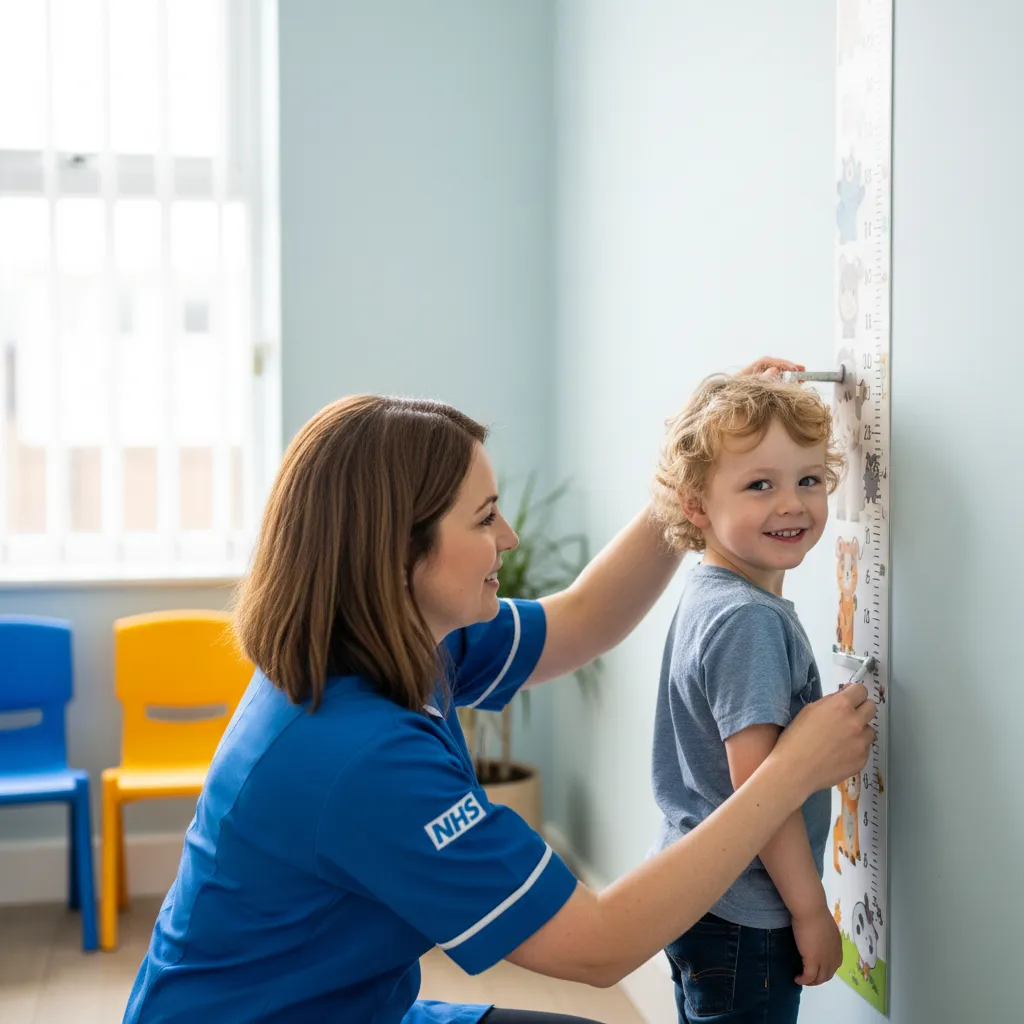
- Measure height against a flat wall with feet together, heels touching the wall, and eyes looking straight ahead
- For children under two, your health visitor will measure their length lying down using a specialist measuring mat
- Record measurements at the same time of day for consistency
For a fuller picture of what typical measurements look like at different ages, have a look at our article on average weight and height for children by age in the UK. Remember, though, that averages are just that. The 50th centile is not a target; it is simply the midpoint.
| BMI Centile | Classification | Action Needed |
|---|---|---|
| Below 2nd centile | Underweight | GP assessment recommended |
| 2nd to 9th centile | Low healthy weight | Monitor growth regularly |
| 9th to 91st centile | Healthy weight | Continue balanced diet and activity |
| 91st to 98th centile | Overweight | Review diet and activity levels |
| Above 98th centile | Very overweight (obese) | GP support advised |
Common Causes of Low Weight in Children
When a child is underweight, there is usually an identifiable reason. In my experience, the causes tend to fall into a few broad categories.
Inadequate calorie intake
This is the most common cause I see in practice. Children may simply not be eating enough to meet their energy needs. This can happen for many reasons: fussy eating, a busy schedule that means meals are rushed or skipped, excessive milk or juice intake that suppresses appetite, or portion sizes that are too small for a growing child. Our guide on how to get your child to eat vegetables offers practical strategies if selective eating is part of the picture.
Increased energy demands
Some children burn through calories faster than they can consume them. Children who are very physically active, those going through a growth spurt, or those with conditions like ADHD (which can increase restlessness and fidgeting) may need more energy than expected. If your child takes ADHD medication, appetite suppression is a well-known side effect. You can read more in our article on ADHD and diet in children.
Medical conditions
A range of underlying health conditions can cause or contribute to low weight in children, including:
- Coeliac disease, which affects around 1 in 100 people in the UK and can cause poor nutrient absorption
- Food allergies or intolerances, particularly cow’s milk protein allergy in younger children
- Gastro-oesophageal reflux, which can make eating uncomfortable
- Thyroid disorders, particularly hyperthyroidism
- Chronic infections or recurrent illnesses
- Congenital heart conditions, which increase the body’s energy demands
Emotional and psychological factors
Stress, anxiety, bullying, family disruption and low mood can all suppress a child’s appetite. In older children and teenagers, disordered eating behaviours may also be a factor. I will discuss the emotional side of weight in more detail later in this article.
Faltering growth in younger children
Health professionals use the term “faltering growth” (previously known as “failure to thrive”) when a young child’s weight gain slows significantly or stops altogether. According to NICE clinical guidelines on faltering growth, this is usually identified when a child’s weight falls through two or more centile spaces on the growth chart. If your little one is under three, our toddler nutrition guide covers the essentials of feeding during this critical stage.

Signs Your Child May Be Underweight
Beyond what the scales say, there are several physical and behavioural signs that may indicate your child is not getting enough nutrition:
- Visible ribs, spine or shoulder blades when the child is undressed
- Clothes becoming looser over time or not moving up to the next size as expected
- Low energy levels or tiring more quickly than peers during play and physical activity
- Frequent illness or taking longer than usual to recover from infections
- Poor concentration at school or difficulty focusing on tasks
- Dry, dull hair or brittle nails, which can indicate nutritional deficiencies
- Delayed puberty in older children
- Feeling cold more often than other children
If you are noticing several of these signs together, it is worth booking an appointment with your GP. Trust your instincts as a parent. You know your child better than anyone, and if something does not feel right, it is always worth investigating.
What to Do If Your Child Is Underweight
If you suspect your child is underweight, here is a step-by-step approach I recommend to the families I work with:
Step 1: Get an accurate assessment. Use the NHS BMI calculator or ask your GP or health visitor to plot your child on the UK-WHO growth charts. One measurement alone is not enough; ask for your child’s growth pattern over time.
Step 2: Rule out medical causes. Your GP can arrange blood tests to check for conditions such as coeliac disease, thyroid problems, iron deficiency anaemia and other nutritional deficiencies. This is an important step that should not be skipped.
Step 3: Keep a food diary. Before making changes, spend three to five days recording everything your child eats and drinks, including portion sizes and times. This gives a much clearer picture than relying on memory alone and is incredibly useful if you are referred to a dietitian.
Step 4: Review the home food environment. Are mealtimes calm and structured? Is your child filling up on drinks between meals? Are there regular opportunities to eat throughout the day? Sometimes small environmental changes make a significant difference.
Step 5: Seek specialist support if needed. If your child’s weight does not improve with dietary changes over four to six weeks, ask your GP for a referral to a paediatric dietitian through the NHS.
Nutrition Strategies to Help Your Child Gain Weight Healthily
When parents hear that their child needs to gain weight, many instinctively reach for crisps, sweets and takeaways. I understand the impulse, but healthy weight gain is about nutrient-dense, energy-rich foods, not empty calories. Here are the strategies I use most often in clinical practice.
Boost calories without increasing portion sizes
Many underweight children have small appetites, so piling more food on their plate can be counterproductive. Instead, try enriching the foods they already eat:
- Add butter, cheese or cream to mashed potatoes, pasta sauces, soups and scrambled eggs
- Use full-fat milk and yoghurt rather than skimmed or semi-skimmed varieties
- Stir nut butters (if no allergy) into porridge, smoothies or spread on toast
- Drizzle olive oil over vegetables, rice and pasta dishes
- Top cereals and puddings with ground seeds, dried fruit or honey (for children over one)
Offer three meals and two to three snacks daily
Structure is vital. Aim for three main meals and at least two substantial snacks spaced roughly two to three hours apart. Snacks should be more than a biscuit; think cheese and crackers, a banana with peanut butter, hummus with pitta bread, or a small bowl of cereal with full-fat milk. For more ideas, take a look at our collection of 30 healthy snack ideas for children.
Prioritise protein at every meal
Protein is essential for muscle growth and repair. Good sources include eggs, chicken, fish, beans, lentils, cheese, yoghurt and tofu. Try to include a protein source at every meal and most snacks.
Manage fluid intake carefully
One of the most overlooked factors I see is excessive fluid intake. Children who drink large volumes of milk, juice or squash between meals often have little appetite left for food. Offer water between meals and save milk for mealtimes or snack times. Our article on how much water a child should drink per day has helpful guidance on getting the balance right.
Make food enjoyable
Pressure and anxiety at mealtimes are the enemy of healthy eating. Keep the atmosphere relaxed and positive. Eat together as a family when you can, involve your child in meal planning and preparation, and never force a child to finish their plate. Getting children involved in the kitchen can be a game-changer; our guide on cooking with children has age-appropriate ideas to try.
| Food Swap | Approximate Extra Calories | How to Use |
|---|---|---|
| Semi-skimmed milk → full-fat milk (200ml) | +30 kcal | On cereal, in cooking, as a drink |
| Plain toast → toast with butter and peanut butter | +200 kcal | Breakfast or snack |
| Boiled vegetables → vegetables with butter and cheese | +100 kcal | Lunch or dinner side |
| Plain porridge → porridge with banana, honey and seeds | +150 kcal | Breakfast |
| Low-fat yoghurt → full-fat Greek yoghurt with dried fruit | +80 kcal | Snack or dessert |
| Plain pasta → pasta with olive oil, cheese and cream sauce | +180 kcal | Main meal |

When to See Your GP or a Specialist
While many cases of low weight in children can be managed with dietary adjustments at home, there are situations where professional medical input is essential. I would strongly advise seeing your GP if:
- Your child’s BMI is below the 2nd centile on the growth charts
- Their weight has dropped across two or more centile lines over a period of weeks or months
- They are losing weight despite eating what seems like a reasonable amount
- You notice symptoms like persistent tiredness, frequent infections, abdominal pain or diarrhoea
- Your child is refusing food entirely or showing signs of disordered eating
- They have an existing medical condition that may be affecting their growth
- Your child seems to be eating a lot but not gaining weight, which could point to malabsorption
Your GP may refer your child to a paediatric dietitian, a paediatrician, or in some cases a specialist feeding clinic. According to the Royal College of Paediatrics and Child Health (RCPCH) growth chart guidance, any child whose weight falls below the 0.4th centile should be assessed by a paediatrician as a matter of priority.
In some areas of the UK, you can also self-refer to NHS dietetic services. Check with your local authority or ask your health visitor what is available in your area.
Supporting Your Child’s Emotional Wellbeing Around Weight
This is something I feel very strongly about. The language we use around weight, food and bodies has a profound impact on children’s self-esteem and their relationship with food. Even well-meaning comments like “you need to eat more” or “you’re too skinny” can cause lasting harm.
Here are some principles I encourage every parent to follow:
- Avoid labelling your child as “underweight” or “skinny” in front of them. Focus on health and energy rather than numbers on a scale.
- Never compare your child’s body or eating habits to those of siblings, friends or classmates.
- Frame food positively: talk about what foods help their body grow strong and give them energy rather than categorising foods as “good” or “bad”.
- Be mindful of your own relationship with food and body image. Children are incredibly perceptive and will mirror your attitudes.
- If your child is aware of their low weight, acknowledge their feelings and reassure them that bodies come in different shapes and sizes.
For a deeper exploration of this topic, I recommend reading our comprehensive guide on body image and self-esteem in children. It is also worth being aware of the signs of emotional eating in children, which can manifest as both over-eating and under-eating.
Underweight vs Naturally Slim: How to Tell the Difference
This is one of the most important distinctions I help parents understand. Not every slim child is underweight, and not every slim child needs to gain weight. Genetics play a significant role in body shape and size, and some children are simply built with a naturally lean frame.
A naturally slim child will typically:
- Track consistently along the same centile line (even if it is a lower one like the 9th or 25th)
- Have good energy levels and be active and alert
- Eat a varied diet, even if portions seem small to you
- Meet their developmental milestones on time
- Have parents or siblings who are also naturally slim
An underweight child who needs support will often show a different pattern: a drop in their growth trajectory, signs of fatigue or poor concentration, frequent illness, or visible signs of nutritional deficiency. If your child has always been on the lighter side but is thriving in every other way, they are very likely just fine.
That said, it is always worth checking in with your GP or health visitor if you have any doubts. A brief growth assessment can provide enormous peace of mind. For more on understanding what healthy weight looks like across childhood, you might find our article on BMI and weight assessment in children helpful, as it covers the same growth chart principles from the opposite perspective.
Getting enough quality sleep is also essential for healthy growth. Growth hormone is primarily released during deep sleep, so ensuring your child has a consistent bedtime routine supports both their weight and overall development.
Key Points
- Check your child’s BMI using the NHS BMI calculator and compare it to UK-WHO growth chart centiles, not adult BMI categories
- Keep a 3 to 5 day food diary to identify gaps before making dietary changes
- Enrich existing meals with butter, cheese, nut butters and full-fat dairy rather than relying on junk food for extra calories
- See your GP if your child’s weight falls below the 2nd centile or has dropped across two or more centile lines
- Use positive, health-focused language around food and body shape to protect your child’s emotional wellbeing
Frequently Asked Questions
When should I worry about my child being underweight?
You should seek medical advice if your child’s BMI falls below the 2nd centile on the UK-WHO growth charts, if their weight has dropped across two or more centile lines, or if they are showing signs such as persistent fatigue, frequent illness, poor concentration or visible signs of nutritional deficiency. A single low reading is less concerning than a downward trend over time. If in doubt, book an appointment with your GP or health visitor for a growth assessment.
How can I help my underweight child gain weight healthily?
Focus on nutrient-dense, energy-rich foods rather than sugary or highly processed options. Add butter, cheese, cream and nut butters to meals your child already enjoys. Offer three meals and two to three substantial snacks each day. Use full-fat dairy products, include a protein source at every meal, and limit fluids between meals so they do not suppress appetite. Keep mealtimes relaxed and avoid pressuring your child to eat more than they are comfortable with.
Why is my child so skinny but eats a lot?
Some children have a naturally fast metabolism or are extremely physically active, which means they burn through calories quickly. However, if your child is eating well but genuinely not gaining weight, it is important to rule out medical causes such as coeliac disease, thyroid disorders or food intolerances that can affect nutrient absorption. Your GP can arrange simple blood tests to check for these conditions.
What is the difference between underweight and naturally slim?
A naturally slim child tracks consistently along the same centile line (even a lower one), has good energy levels, eats a varied diet, and meets their developmental milestones. An underweight child typically shows a downward trend on the growth charts, may have low energy, frequent illness, or signs of nutritional deficiency. Genetics play a significant role; if parents and siblings are naturally lean, a slim build may simply be your child’s normal body type.
Should I give my underweight child nutritional supplements?
In most cases, a food-first approach is recommended before turning to supplements. Focus on enriching your child’s diet with energy-dense whole foods. However, your GP or a paediatric dietitian may recommend specific supplements such as vitamin D, iron or prescribed nutritional drinks if blood tests reveal deficiencies or if dietary changes alone are not sufficient. Never start supplements without professional guidance, as some can be harmful in excessive amounts.
What does the NCMP letter mean if it says my child is underweight?
The National Child Measurement Programme measures children in Reception (age 4 to 5) and Year 6 (age 10 to 11) in England. If the letter indicates your child is underweight, it means their BMI fell below the 2nd centile at the time of measurement. This is a screening result, not a diagnosis. Book an appointment with your GP to discuss the result, have your child’s growth plotted over time, and rule out any underlying medical causes.