Key Takeaways
- A child’s portion size should be roughly the size of their own palm or fist, not an adult’s
- Children aged 1 to 4 need approximately half an adult portion for most food groups
- The NHS recommends children eat 5 portions of fruit and vegetables daily, with a child-sized portion being about 40g for toddlers and 80g for older children
- Starchy carbohydrates should make up just over a third of each meal, following the Eatwell Guide
- Protein portions for children aged 5 to 11 are roughly the size of their palm, around 60 to 80g of cooked meat or fish
- Dairy needs vary by age: children aged 1 to 3 require around 350mg of calcium daily, rising to 550mg for ages 7 to 10
In This Article
- Why Portion Sizes Matter for Children
- Understanding Child-Sized Portions
- Portion Sizes for Toddlers: 1 to 4 Years
- Portion Sizes for Children: 5 to 11 Years
- Portion Sizes for Teenagers: 12 to 17 Years
- Using Hands and Everyday Objects as Portion Guides
- Common Portion Size Mistakes Parents Make
- Practical Tips for Getting Portions Right
Why Portion Sizes Matter for Children
As a paediatric nutritionist, one of the most common questions I hear from parents is: “How much should my child actually be eating?” It is a brilliant question, and one that many families find genuinely confusing. In my 15 years of practice across the NHS and private clinics in Bristol, I have seen how oversized portions have become so normalised that many of us have lost sight of what an appropriate amount of food looks like for a growing child.
Getting portion sizes right matters enormously. Serving children adult-sized helpings, even of healthy foods, can contribute to excess calorie intake and gradual weight gain over time. According to the NHS advice for parents of healthy-weight children, understanding appropriate portions is one of the most effective steps families can take to support a healthy weight. On the other hand, portions that are too small may mean children miss out on essential nutrients they need for growth and development.
The challenge is that children’s nutritional needs change significantly as they grow. A two-year-old and a twelve-year-old have vastly different energy requirements, and their plates should reflect that. Throughout this guide, I will walk you through age-appropriate portion sizes based on NHS recommendations, practical measuring tools you can use at home, and common mistakes I see families making in my clinic every week.
If you are also concerned about your child’s overall diet quality, my guide to the Eatwell Guide for children and families provides a helpful foundation for understanding food groups and balance.
Understanding Child-Sized Portions
Before we look at specific ages, it helps to understand a few key principles that underpin NHS portion guidance for children.
First, children are not small adults. Their stomachs are significantly smaller, roughly the size of their clenched fist, and they process food differently. A child aged two has a stomach capacity of approximately 200 to 250ml, compared to around 1,000ml for an adult. This means they physically cannot manage large meals and are better served by three smaller meals and two to three snacks spread across the day.
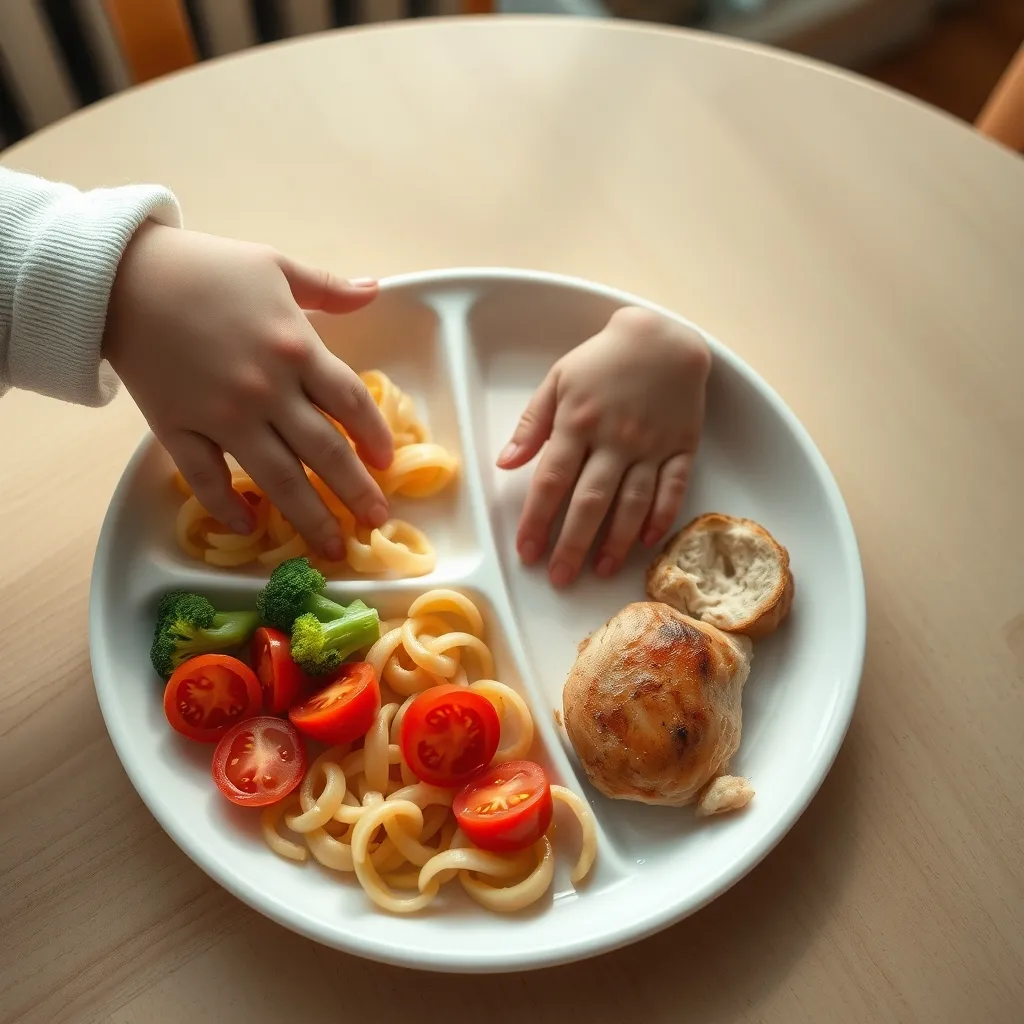
Second, the British Nutrition Foundation’s portion size guidance emphasises that children’s portions should be scaled to their age and body size. The simplest rule I share with parents in my clinic is this: use your child’s hand as the measuring tool, not your own. Their palm, fist, and cupped hand provide naturally proportionate guides that grow as they do.
Third, appetite naturally fluctuates. Children go through growth spurts, periods of illness, and phases of fussy eating. A child who cleans their plate one day and barely touches it the next is usually responding to genuine hunger signals. I always encourage parents to serve appropriate portions and let the child decide how much to eat, rather than insisting they finish everything.
The Eatwell Guide, which applies from age two onwards, recommends the following proportions on the plate:
- Just over a third from starchy carbohydrates (bread, rice, pasta, potatoes)
- Just over a third from fruit and vegetables
- Smaller amounts of protein (meat, fish, eggs, beans, pulses)
- Some dairy or dairy alternatives
- Very small amounts of oils and spreads
Understanding these proportions is essential before we talk about actual quantities. For more on building balanced meals without breaking the bank, have a look at my article on budget-friendly healthy meals for families.
Portion Sizes for Toddlers: 1 to 4 Years
This age group requires the most careful attention to portions, partly because toddlers are transitioning from milk-based diets to solid foods, and partly because their energy needs per kilogram of body weight are actually higher than older children’s. However, their tiny stomachs mean meals must be small and nutrient-dense.
For children aged 1 to 4, I recommend these approximate portion sizes, based on NHS Trust guidance and the British Nutrition Foundation’s recommendations:
| Food Group | Example Foods | Portion Size (Age 1-2) | Portion Size (Age 3-4) |
|---|---|---|---|
| Starchy carbohydrates | Pasta, rice, bread, potatoes | 2-3 tablespoons cooked pasta/rice; half a slice of bread | 3-4 tablespoons cooked pasta/rice; 1 small slice of bread |
| Fruit and vegetables | Any fruit or veg | 1-2 tablespoons veg; half a small fruit | 2-3 tablespoons veg; 1 small fruit |
| Protein | Meat, fish, eggs, beans | 1-2 tablespoons mince; half an egg; 1-2 tablespoons beans | 2-3 tablespoons mince; 1 egg; 2-3 tablespoons beans |
| Dairy | Milk, cheese, yoghurt | 100ml milk; 1 small pot yoghurt (60g); thumb-sized cheese | 150ml milk; 1 small pot yoghurt (80-100g); matchbox-sized cheese |
| Fats and oils | Butter, oil, spreads | Thin spread on bread; 1 teaspoon oil in cooking | Thin spread on bread; 1 teaspoon oil in cooking |
A few important notes for this age group. Children under two should have full-fat dairy products because they need the extra energy and fat-soluble vitamins. From age two, you can gradually move to semi-skimmed milk if the child is eating well and growing normally. For toddlers aged 1 to 3, the recommended daily calorie intake is approximately 1,000 to 1,200 calories, though this varies significantly by individual.
I see many parents worrying that their toddler is not eating enough. In most cases, if a child is growing along their expected centile line on their growth chart and is active and alert, they are likely getting what they need. If you are concerned, have a look at my advice on fussy eating in children for practical strategies.
One common pitfall at this age is offering too much milk or juice between meals. Toddlers should have no more than 300 to 400ml of milk per day after their first birthday, and fruit juice should be diluted (one part juice to ten parts water) and limited to mealtimes only.
Portion Sizes for Children: 5 to 11 Years
Once children reach school age, their energy needs increase noticeably. A child aged 5 to 6 needs roughly 1,400 to 1,600 calories per day, while a child aged 9 to 11 may need 1,800 to 2,000 calories, depending on their activity level, size, and rate of growth. This is the age range where I most commonly see portion sizes creeping up to adult levels, particularly for foods like pasta, cereal, and rice.
For this age group, a good rule of thumb is that portions should be approximately two-thirds of an adult portion for most food groups. Here is what that looks like in practice:
Starchy carbohydrates (each meal): 4 to 6 tablespoons of cooked rice or pasta; 1 medium slice of bread; 1 to 2 egg-sized potatoes. Aim for wholegrain varieties where possible, as they provide more fibre and keep children fuller for longer.
Fruit and vegetables (5 portions daily): Each child-sized portion is about 40 to 60g for ages 5 to 7 and closer to 60 to 80g for ages 8 to 11. One portion might be a small apple, a handful of grapes, 3 heaped tablespoons of peas, or a cereal-bowl quantity of salad leaves. Variety matters more than quantity here, so try to include different colours across the day.
Protein (twice daily): A portion of meat or fish is roughly the size of the child’s palm, around 60 to 80g cooked weight. For beans or lentils, 4 to 5 tablespoons makes a good serving. One to two eggs count as a portion. Oily fish such as salmon or mackerel should be included at least once a week.
Dairy (2 to 3 servings daily): A 200ml glass of milk, a matchbox-sized piece of cheese (about 30g), or a 125g pot of yoghurt each count as one serving. Children in this age group need approximately 450 to 550mg of calcium daily to support bone development.
School lunches can be tricky territory when it comes to portions. If your child takes a packed lunch, my guide to healthy packed lunch ideas includes practical portion advice. If they eat school dinners, you might find my article on whether school meals are healthy helpful for understanding what they are being served.
Snacks are an important part of children’s diets at this age, but they should be planned rather than grazed on. A healthy snack portion might be a piece of fruit with a tablespoon of nut butter, a small pot of yoghurt, or a few oatcakes with cheese. For more ideas, see my suggestions for healthy after-school snacks.
Portion Sizes for Teenagers: 12 to 17 Years
Adolescence brings rapid growth, hormonal changes, and significantly increased energy needs. Teenage boys aged 13 to 17 may need between 2,200 and 2,800 calories daily, while girls in the same age range typically need 2,000 to 2,400 calories. This is the period when many teenagers begin eating adult-sized portions, and for the most part, that is appropriate.
However, not all calories are equal, and I see many teenagers in my practice who are consuming enough energy but not enough nutrients. Common deficiencies in this age group include iron (particularly in girls after menstruation begins), calcium, and vitamin D. For more on iron specifically, my article on iron deficiency in children covers the symptoms to watch for and the best dietary sources.
Portion guidance for teenagers:
Starchy carbohydrates: Adult-sized portions are appropriate. This means approximately 6 to 8 tablespoons of cooked pasta or rice, 2 slices of bread, or 2 to 3 egg-sized potatoes per meal. At least half should be wholegrain.
Fruit and vegetables: Full adult portions of 80g each, with a target of 5 or more per day. Many teenagers fall well short of this. A smoothie can count as one portion, but only one per day regardless of how many fruits are blended.
Protein: A palm-sized piece of meat or fish (approximately 80 to 120g cooked weight), or 5 to 6 tablespoons of beans or lentils. Two eggs make a serving. Teenagers involved in sport may benefit from slightly larger protein portions spread across the day, but protein supplements are rarely necessary and I generally advise against them for under-18s.
Dairy: Three servings daily to meet the higher calcium requirement of 800 to 1,000mg per day. A 200ml glass of milk, a 150g pot of yoghurt, or 30 to 40g of cheese each count as one serving.
I want to add an important note about teenagers and portion control. This is an age when disordered eating patterns can develop, and I am always cautious about how we frame food conversations with adolescents. The emphasis should be on eating enough of the right foods, not on restriction. If you notice your teenager becoming preoccupied with portion sizes, counting calories, or avoiding food groups, please read my article on eating disorders in children and teenagers and seek professional advice.

Using Hands and Everyday Objects as Portion Guides
Weighing food at every meal is neither practical nor advisable. It can create an unhealthy focus on measurement, particularly for children who are old enough to notice. Instead, I teach families to use hand-based and visual guides that are quick, easy, and naturally scale with the child’s size.
Here is the system I use in my clinic, adapted from NHS and British Nutrition Foundation guidance:
The child’s fist equals one portion of starchy carbohydrates (cooked rice, pasta, or potatoes). This is my single most useful tip for parents, as it instantly adjusts for age.
The child’s palm (without fingers) equals one portion of meat or fish. The thickness should be roughly equivalent to a deck of cards.
The child’s cupped hand equals one portion of dry cereal, nuts (for children over five with no allergy risk), or small fruits like berries and grapes.
The child’s thumb (from tip to base) equals one portion of cheese or peanut butter.
The child’s thumbnail equals one portion of butter or cooking oil.
For everyday objects, these visual comparisons work well:
- A tennis ball is roughly one portion of fruit for children aged 5 and over
- A matchbox is one portion of cheese (about 30g)
- A golf ball is one portion of cooked meat for a toddler
- A standard cereal bowl filled to two-thirds is an appropriate cereal portion for a primary school child
These guides are deliberately approximate. The goal is not precision but a reasonable, consistent framework that stops portions from gradually inflating over time. I find that most families, once they start using these guides, are surprised to discover they have been routinely serving portions that are 30 to 50 per cent larger than recommended.
Common Portion Size Mistakes Parents Make
In my years of clinical practice, certain patterns come up again and again. Recognising these common mistakes can help you make simple adjustments that have a significant impact on your child’s overall intake.
Using adult-sized plates and bowls. Research consistently shows that larger dishes lead to larger servings. Children aged 1 to 5 should eat from a child-sized plate, roughly 17 to 20cm in diameter. Even for older children, a standard side plate (about 20cm) is more appropriate than a full dinner plate (27cm). This single change can reduce portion sizes by up to 25 per cent without the child feeling deprived.
Pouring cereal directly from the box. Breakfast cereals are one of the foods most commonly over-served. A recommended portion of most cereals for a child aged 5 to 10 is around 30 to 40g, which looks surprisingly small in a bowl. I suggest measuring once with kitchen scales so you know what the correct amount looks like, then using that as your visual reference going forward.
Offering unlimited drinks. Calories from drinks count, and they are easy to overlook. Fruit juice, squash, smoothies, and flavoured milk can all add significant energy without satisfying hunger. The government guidance for early years providers recommends that children aged 1 to 5 drink mainly water and plain milk. For more detail on managing sugary drinks and foods, my article on how much sugar a child should have per day is a useful companion to this guide.
Treating all snacks as “extra” food. Snacks should be considered part of the day’s overall nutrition, not additions on top of three full meals. If a child has had a substantial snack between lunch and dinner, it is perfectly reasonable for their dinner portion to be slightly smaller.
The “clean plate” expectation. Insisting children finish everything on their plate teaches them to override their natural fullness cues. Instead, serve an appropriate portion and let them stop when they are satisfied. If they consistently leave food, you may simply be serving too much. For more on creating healthy attitudes around eating, I recommend my article on positive mealtime habits.
Forgetting that cooking changes volume. Dried pasta roughly doubles in weight when cooked. Rice can triple. A portion that looks tiny when dry may be perfectly adequate once cooked. Always refer to cooked weights when assessing portion sizes.
Practical Tips for Getting Portions Right
Here are my most practical recommendations for managing portions day to day, drawn from what I have seen work best for the families I support.
Serve food in the kitchen, not at the table. Plating up in the kitchen gives you control over portion sizes. Family-style serving, where dishes are placed in the centre of the table, tends to encourage second helpings and makes it harder to monitor how much each child eats.
Use the “divided plate” approach. For children aged 2 and over, visualise the plate in sections: half filled with vegetables and fruit, a quarter with starchy carbohydrates, and a quarter with protein. This simple framework follows the Eatwell Guide proportions and makes portion sizing intuitive.
Let children serve themselves occasionally. From around age 4 or 5, allowing children to serve themselves from time to time (with guidance) helps them learn to recognise appropriate amounts. Studies suggest that children who self-serve often take less food than adults would plate up for them.
Keep a portion reference on the fridge. Print out a simple hand-based portion guide and stick it where you prepare food. After a few weeks, it becomes second nature, but having the visual reminder during the learning period is genuinely helpful.
Do not use food as a reward. “Finish your peas and you can have pudding” is a phrase most of us grew up hearing, but it teaches children that dessert is the prize and vegetables are the ordeal. Both are simply food, and treating them equally helps children develop a balanced relationship with eating.
Adjust for activity. A child who has spent the afternoon at football training will genuinely need more food than one who has been watching television. It is fine to offer slightly larger portions or an extra snack on active days. My guide to physical activity guidelines for children by age explains how much activity children need, which can help you gauge their energy requirements.
If you are concerned that your child’s weight is already above a healthy range and you want to adjust portions carefully, my detailed guide on how to help your child lose weight safely walks through the process step by step, without resorting to restrictive diets.
Key Points
- Use your child’s hand as a portion guide: their fist for carbohydrates, their palm for protein, their thumb for cheese
- Serve meals on child-sized plates (17-20cm) to naturally reduce portion sizes by up to 25%
- Aim for 5 portions of fruit and vegetables daily, remembering that a child-sized portion is smaller than an adult one
- Plate up food in the kitchen rather than placing serving dishes on the table
- Let children stop eating when they feel full; never insist on a clean plate
Frequently Asked Questions
What is a good portion size for a child?
A good portion size depends on the child’s age, but the simplest guide is to use your child’s own hand as the measuring tool. Their clenched fist represents one portion of carbohydrates such as pasta or rice, and their palm represents one portion of meat or fish. For toddlers aged 1 to 4, portions are roughly half an adult serving. For children aged 5 to 11, portions are approximately two-thirds of an adult serving. Teenagers can generally eat adult-sized portions of most foods.
Calorie needs vary by age, sex, and activity level. As a general guide: children aged 1 to 3 need approximately 1,000 to 1,200 calories per day; children aged 4 to 6 need around 1,400 to 1,600 calories; children aged 7 to 10 need roughly 1,600 to 2,000 calories; and teenagers may need between 2,000 and 2,800 calories. However, I recommend focusing on portion sizes and food quality rather than counting calories, especially with children.How many calories does a child need per day?
The NHS recommends that children aged 2 and over follow the Eatwell Guide, which advises eating plenty of fruit and vegetables (at least 5 a day), basing meals on starchy carbohydrates (preferably wholegrain), including some protein from meat, fish, eggs or beans, having some dairy or dairy alternatives, and choosing unsaturated oils in small amounts. Children should also limit foods high in sugar, salt, and saturated fat, and drink plenty of water.What are the NHS guidelines for healthy eating for children?
Routinely weighing food is not necessary and can create an unhealthy focus on measurement, particularly for older children who may notice. Instead, use hand-based portion guides: your child’s fist for carbohydrates, their palm for protein, and their thumb for cheese. I suggest weighing a portion once or twice so you know what the correct amount looks like in your usual bowls and plates, then using that as your visual reference going forward.Should I weigh my child’s food to get portions right?
The most reliable indicator is your child’s growth pattern. If they are growing steadily along their expected centile line on their growth chart, they are almost certainly eating an appropriate amount. Signs of consistent overeating include rapid weight gain that crosses centile lines upwards, while signs of undereating include poor energy levels, frequent illness, and weight dropping below expected centiles. If you have concerns, speak to your GP or health visitor, who can check your child’s growth chart and offer guidance.How do I know if my child is eating too much or too little?
A child-sized portion of fruit or vegetables is roughly what fits in the palm of their hand. For toddlers aged 1 to 4, this is approximately 40g, which might be one small satsuma, a few florets of broccoli, or 2 tablespoons of peas. For children aged 5 to 11, a portion is around 40 to 60g, building towards the full adult portion of 80g by the time they reach their teens. Children should aim for 5 portions per day from a variety of different fruits and vegetables.What is a child-sized portion of fruit and vegetables?