Key Takeaways
- Children need 2 balanced snacks per day to maintain energy levels between meals
- Only 18% of UK children aged 5 to 15 eat the recommended five portions of fruit and vegetables daily
- Pairing a carbohydrate with a protein source keeps blood sugar stable and helps children concentrate at school
- School snack boxes should be kept nut-free unless your school confirms otherwise, due to allergy policies
- Preparing snacks together at the weekend takes under 30 minutes and gives children ownership over healthy choices
- Swapping ultra-processed snack bars for whole-food alternatives can reduce a child’s daily free sugar intake by up to 50%
In This Article
- Why Healthy Snacks Matter for Children
- What Makes a Good Snack? The Basics
- 10 Healthy Snack Ideas for School
- 10 After-School and Weekend Snack Ideas
- 10 No-Cook Quick Snacks for Busy Days
- Snack Comparison: Processed vs Homemade
- Managing Snack Portions by Age
- Allergies, Dietary Needs and School Policies
- Getting Children Involved in Snack Preparation
Why Healthy Snacks Matter for Children
As a paediatric nutritionist, one of the most common questions I hear from parents is: “What on earth do I put in my child’s snack box?” It is a question I completely understand. Between school policies, fussy eating and the sheer pace of family life, finding healthy snacks children will actually enjoy can feel like an uphill battle.
But snacks are far more than a way to stop hunger pangs. For growing children, well-chosen snacks bridge the gap between meals and provide essential nutrients their developing bodies need. The NHS Eatwell Guide recommends that children eat regular meals and healthy snacks throughout the day, particularly during school hours when concentration and energy demands are high.
Research from the National Diet and Nutrition Survey shows that snacks contribute roughly 20% of a child’s total daily calorie intake. That is a significant proportion, and it means the quality of those snacks genuinely matters. When children reach for crisps, biscuits or sugary cereal bars, they fill up on empty calories and miss the chance to take in vitamins, minerals and fibre their bodies need.
I have seen first-hand in my Bristol clinic how swapping just two daily snacks for whole-food alternatives can improve a child’s energy, mood and even their willingness to try new foods at mealtimes. If your child is carrying extra weight, our guide on how to tell if your child is overweight can help you understand where to start, and improving snack choices is often one of the simplest first steps.
What Makes a Good Snack? The Basics
Before I share the 30 ideas, let me explain what I look for in a healthy snack for children at school or at home. A good snack should tick several boxes:
- Combines a carbohydrate with a protein or healthy fat to provide sustained energy rather than a quick spike and crash
- Contains minimal free sugars (the NHS recommends children aged 4 to 6 have no more than 19g of free sugars per day)
- Provides at least one key nutrient such as calcium, iron, fibre, or vitamins A and C
- Is practical for a lunchbox if heading to school: does not need refrigeration, is not too messy, and is easy for small hands to manage
- Tastes good: a snack no one eats is a snack wasted, no matter how nutritious it is
I always remind parents that snacking is not inherently bad. The problem arises when snacks become a stream of ultra-processed foods high in sugar, salt and artificial additives. The goal is not to eliminate snacking but to make it work for your child’s health rather than against it.
10 Healthy Snack Ideas for School
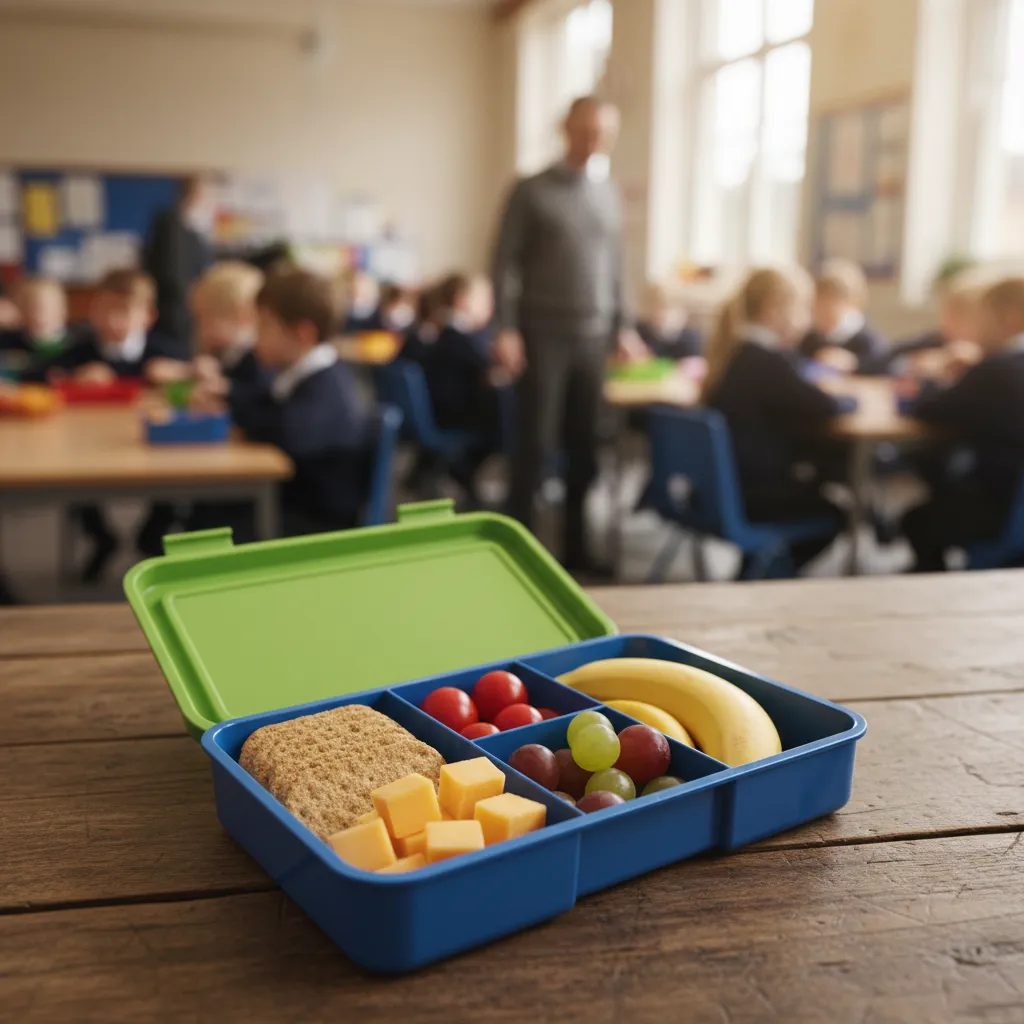
These healthy snacks for children at school are designed to be lunchbox-friendly. They travel well, do not require heating, and most are suitable for nut-free environments. I have tested every one of these with the families I work with.
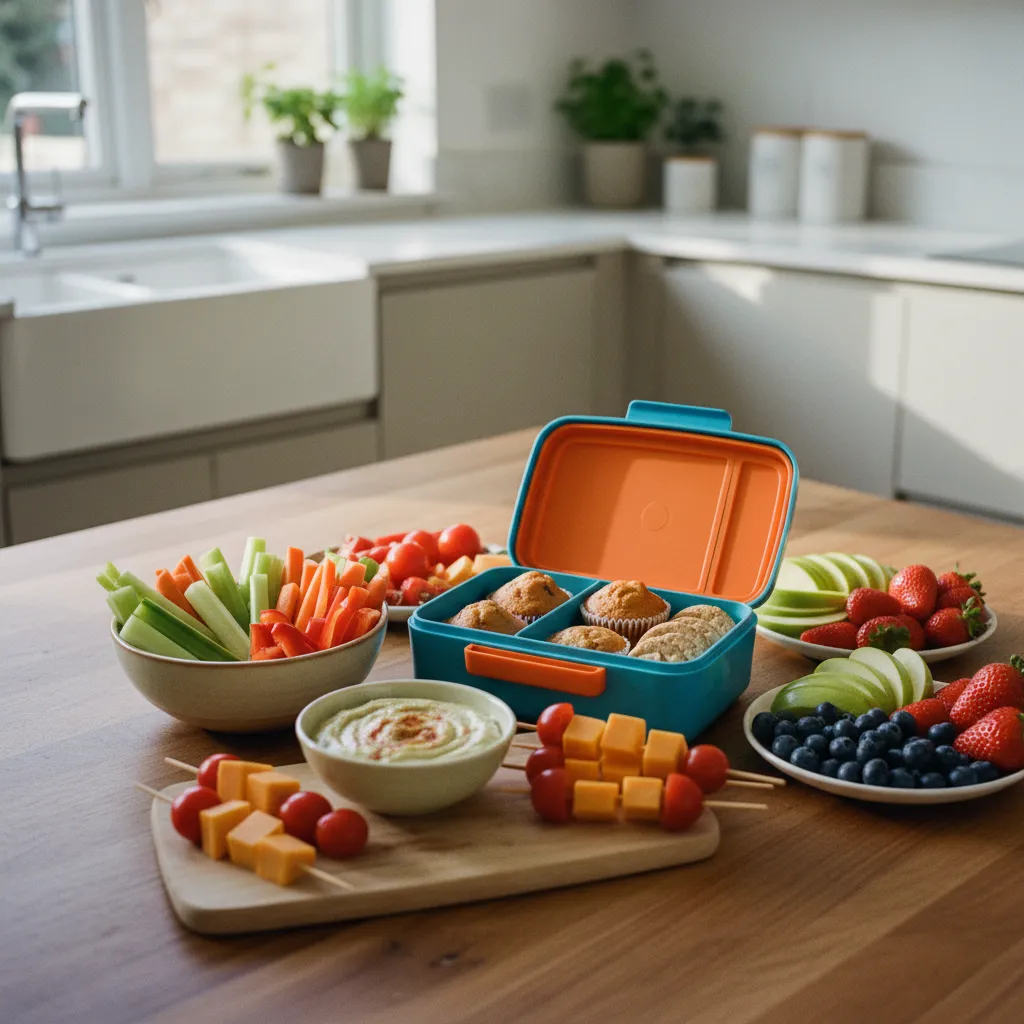
- Oat and banana mini muffins: Made with mashed banana, oats and a splash of milk, these contain no added sugar and freeze beautifully. Bake a batch on Sunday and you are sorted for the week.
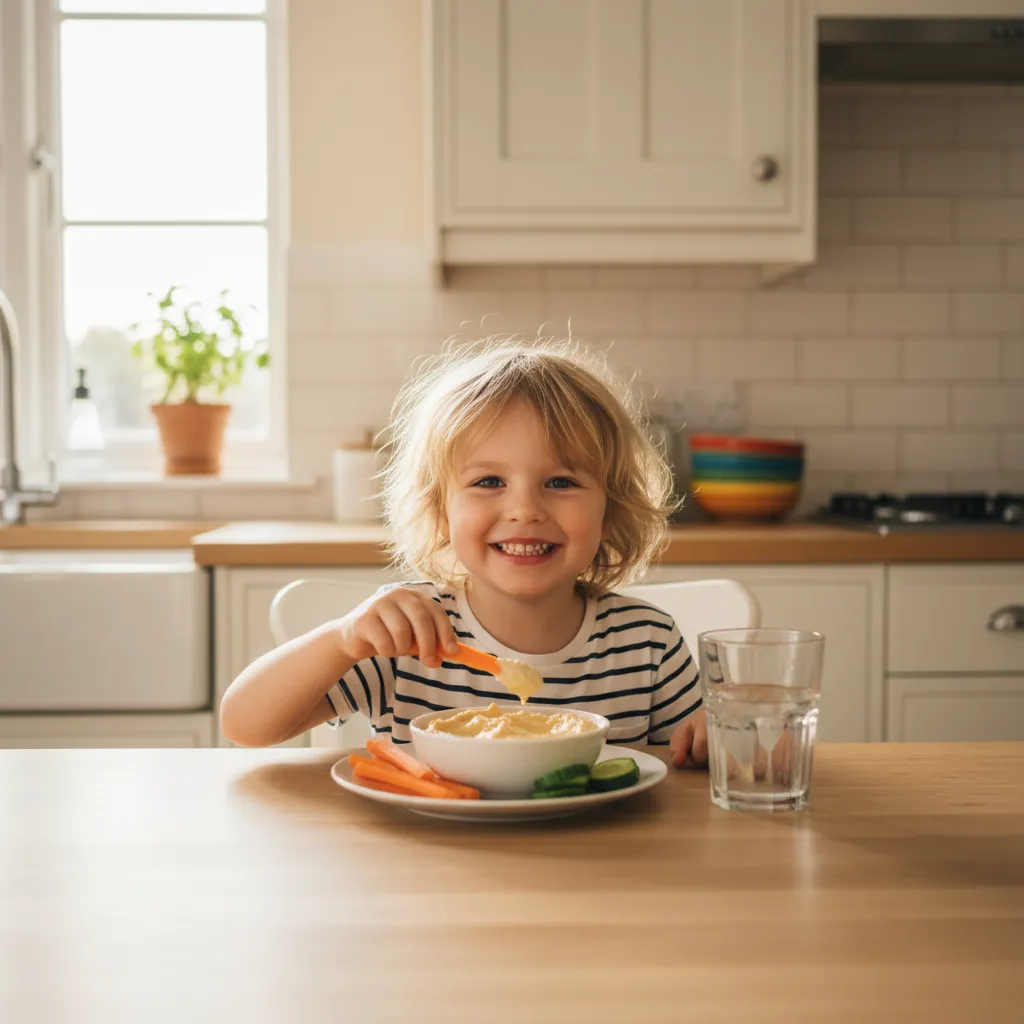
- Vegetable sticks with hummus: Carrot, cucumber and pepper sticks paired with a small pot of hummus provide fibre, protein and vitamin C. Use a leak-proof container to avoid soggy lunchbox disasters.
- Cheese and wholemeal crackers: A matchbox-sized piece of cheddar with 3 to 4 wholemeal crackers delivers calcium and slow-release energy. This is one of the simplest and most reliable school snacks I recommend.
- Apple slices with seed butter: If your school allows seed butters (sunflower or pumpkin seed), a thin spread on apple slices is a brilliant combination of fibre, healthy fats and natural sweetness.
- Homemade flapjack fingers: Use oats, mashed banana and a drizzle of honey (for children over 1) instead of golden syrup. Cut into thin fingers for easy snacking.
- Cherry tomatoes with breadsticks: Quick, colourful and popular with children who enjoy dipping. Choose wholemeal breadsticks for extra fibre.
- Yoghurt tubes (frozen): Pop a natural yoghurt tube in the freezer the night before. By mid-morning break, it will be perfectly thawed and still cool. Check the label and choose options with under 5g of sugar per 100g.
- Mini rice cakes with cream cheese: Spread a thin layer of cream cheese on plain rice cakes. Add a few raisins on top for a touch of sweetness.
- Pitta bread strips with tzatziki: Wholemeal pitta cut into strips with a small pot of cucumber yoghurt dip provides protein, carbohydrate and calcium in one go.
- Fruit and cheese skewers: Thread grapes (halved for younger children), cubes of cheese and chunks of melon onto blunt wooden skewers for a fun, colourful snack that covers fruit and dairy in one.
If your child tends to eat for comfort rather than hunger, our article on emotional eating in children explores how to recognise the signs and respond helpfully.
10 After-School and Weekend Snack Ideas
After-school snacks are often the trickiest. Children come home hungry, tired and looking for something immediately. Having a healthy snack ready to go prevents the default grab for biscuits or crisps. These ideas work well at home where you have access to a fridge and a few extra minutes.
- Wholemeal toast soldiers with scrambled egg: This is more of a mini-meal than a snack, but for active children who have after-school sports, the protein and carbohydrate combination is ideal.
- Smoothie with hidden spinach: Blend a banana, a handful of spinach, a splash of milk and a tablespoon of oats. The banana masks the spinach entirely, and children get a serving of greens without a battle.
- Homemade popcorn: Air-popped popcorn is a wholegrain snack that is surprisingly high in fibre. Season with a tiny pinch of salt or a sprinkle of cinnamon rather than butter or sugar.
- Baked sweet potato wedges: Cut a sweet potato into wedges, toss with a teaspoon of olive oil and bake at 200°C for 20 minutes. Sweet potatoes are rich in vitamin A and fibre, and most children love their natural sweetness.
- Frozen banana lollies: Insert a lolly stick into a peeled banana, dip in natural yoghurt, roll in desiccated coconut or crushed oats, and freeze. A healthy alternative to ice lollies.
- Edamame beans with a pinch of sea salt: These are a brilliant source of plant protein and fun to pop from their pods. Available frozen in most UK supermarkets and ready in 3 minutes.
- Mini wraps with turkey and cucumber: Lay a thin slice of turkey and a few cucumber sticks on a small wholemeal wrap, roll it up and slice in half. Protein, carbohydrate and hydration in a tidy package.
- Fruit salad with a squeeze of lime: Mix seasonal fruits such as strawberries, blueberries, kiwi and satsuma segments. The lime juice stops browning and adds a flavour boost that makes a simple fruit bowl feel more exciting.
- Oatcakes with cottage cheese and pineapple: Oatcakes are a Scottish staple packed with fibre. Top with cottage cheese and a small spoonful of tinned pineapple (in juice, not syrup) for a satisfying combination.
- Vegetable muffin bites: Grate courgette and carrot into a basic savoury muffin mixture with cheese and egg. These freeze well and provide a genuine vegetable serving disguised as a treat.
Getting enough fibre through snacks like these can also help with digestive health. If your child struggles with constipation, our detailed guide on how diet and fibre can help with constipation in children is well worth reading.
10 No-Cook Quick Snacks for Busy Days
I know that not every parent has time to bake muffins or prepare elaborate snack boxes. These 10 ideas require absolutely no cooking and can be assembled in under 2 minutes. They are lifesavers for those mornings when you are running late.
- A banana and a small handful of raisins: The simplest snack in the world, but it works. Bananas provide potassium and quick energy; raisins add iron and fibre.
- Cubes of cheese with grapes: Halve the grapes for children under 5 to reduce choking risk. This pairing offers calcium, protein and natural sugars.
- Natural yoghurt with berries: Spoon plain yoghurt into a small pot and scatter a handful of blueberries or raspberries on top. Avoid flavoured yoghurts, which can contain up to 4 teaspoons of sugar per pot.
- Sliced pear with a thin layer of cream cheese: The combination of juicy fruit and creamy cheese is surprisingly moreish and provides vitamin C along with calcium.
- A hard-boiled egg: Boil a batch at the start of the week and keep them in the fridge. Eggs are one of the most nutrient-dense foods available, packed with protein, B vitamins and choline.
- Cucumber rounds topped with soft cheese and a cherry tomato: These look like little canapés and children often enjoy the novelty. Quick to assemble and refreshing on warm days.
- Wholemeal pitta with mashed avocado: Half an avocado mashed into a small pitta provides healthy monounsaturated fats and fibre. Add a squeeze of lemon juice to prevent browning.
- Dried apricots and a few pumpkin seeds: Dried apricots are an excellent source of iron, particularly useful for children who do not eat much red meat. Keep the portion to around 3 to 4 apricots to limit sugar intake.
- Corn on the cob: A leftover cooked cob from dinner, served cold, makes a surprisingly popular snack. It counts as one of their five a day and is a good source of fibre.
- A slice of malt loaf: Lower in fat and sugar than cake, malt loaf is a traditional British option that provides slow-release energy from its high carbohydrate content. A single slice is the right portion for a child’s snack.
Snack Comparison: Processed vs Homemade
One of the most powerful ways I help parents in my clinic is by comparing what is in a typical shop-bought snack with a homemade alternative. The differences are often striking. This table compares common processed snacks with the whole-food options from our list above.
| Processed Snack | Sugar (per portion) | Homemade Alternative | Sugar (per portion) | Key Nutrients Gained |
|---|---|---|---|---|
| Chocolate cereal bar | 8.5g | Oat and banana mini muffin | 3g (natural) | Fibre, potassium, B vitamins |
| Flavoured yoghurt pouch | 12g | Natural yoghurt with berries | 5g (natural) | Calcium, probiotics, vitamin C |
| Packet of crisps (25g) | 0.5g | Homemade popcorn | 0g | Wholegrain fibre, lower saturated fat |
| Fruit winders | 9g | Apple slices with seed butter | 6g (natural) | Fibre, healthy fats, vitamin E |
| Chocolate biscuit (2 fingers) | 10.5g | Homemade flapjack finger | 4g | Oat fibre, slow-release energy |
| Sugary squash drink (200ml) | 13g | Smoothie with spinach and banana | 7g (natural) | Iron, folate, vitamin A, fibre |
As you can see, the homemade options consistently contain less free sugar and more genuine nutrients. The natural sugars present in fruit and dairy are handled differently by the body than the free sugars added to processed snacks, and they come packaged with fibre, vitamins and minerals. For a deeper look at why this distinction matters, read our article on ultra-processed food and children’s health.
Managing Snack Portions by Age
Portion size is something many parents find confusing, and I completely understand why. A snack that is right for a 10-year-old may be far too large for a 4-year-old, yet packaging rarely makes this distinction. Here is a practical guide to snack portions based on the age groups I work with most frequently.
Children aged 2 to 4: A snack should be roughly the size of their palm. Think half a banana, 2 small crackers with a thin spread of cheese, or a small pot of yoghurt (around 80ml). At this age, children’s stomachs are small and they need to eat more frequently, so 2 to 3 small snacks per day is appropriate.
Children aged 5 to 7: Portions can increase slightly. A whole banana, 3 to 4 crackers with cheese, or a small wrap with filling works well. Two snacks per day, one mid-morning and one after school, is usually sufficient.
Children aged 8 to 12: Active children in this age group may need slightly larger snacks, particularly if they are doing sports. A smoothie, two oatcakes with cottage cheese, or a mini wrap with turkey are all appropriate. Two snacks per day remains the general recommendation.
If you are concerned about your child’s weight, our BMI calculator for children can help you check whether they are in a healthy range. You can also look at the UK child weight chart to understand where your child sits on the growth centiles. Remember that the goal is never to restrict food but to ensure the right balance of nutrients.
Allergies, Dietary Needs and School Policies
Navigating allergies and school food policies adds another layer of complexity to snack planning. In my experience, these practical tips help:
Nut-free schools: The majority of UK primary schools have a nut-free policy. This rules out peanut butter, almond butter and any snack containing tree nuts. Seed butters (sunflower, pumpkin) are usually acceptable alternatives, but always check with your school. If in doubt, stick to the many nut-free options on our list such as cheese and crackers, vegetable sticks with hummus, or yoghurt with fruit.
Dairy-free children: Swap cow’s milk yoghurt for coconut or oat-based alternatives. Use dairy-free cream cheese on rice cakes. Edamame beans and hummus are excellent protein sources that do not rely on dairy.
Gluten-free needs: Rice cakes, oatcakes made from certified gluten-free oats, fruit, vegetables, eggs, cheese and yoghurt are all naturally gluten-free. Many of the snack ideas above require no adaptation at all.
Vegetarian and vegan children: Hummus, seed butters, edamame beans, avocado and nut-free energy bites made with oats and dates are all plant-based options that provide good protein. Ensuring adequate iron, calcium and vitamin B12 through snacks is particularly important for vegan children, and the NHS guidance on vegetarian and vegan diets for children offers clear advice.
It is worth noting that the School Food Standards set by the Department for Education apply to meals provided by schools rather than packed lunches and snacks from home. However, many schools have their own healthy eating policies that may restrict certain items such as sweets, chocolate bars and sugary drinks. Checking your school’s policy at the start of each year saves confusion later.
Getting Children Involved in Snack Preparation
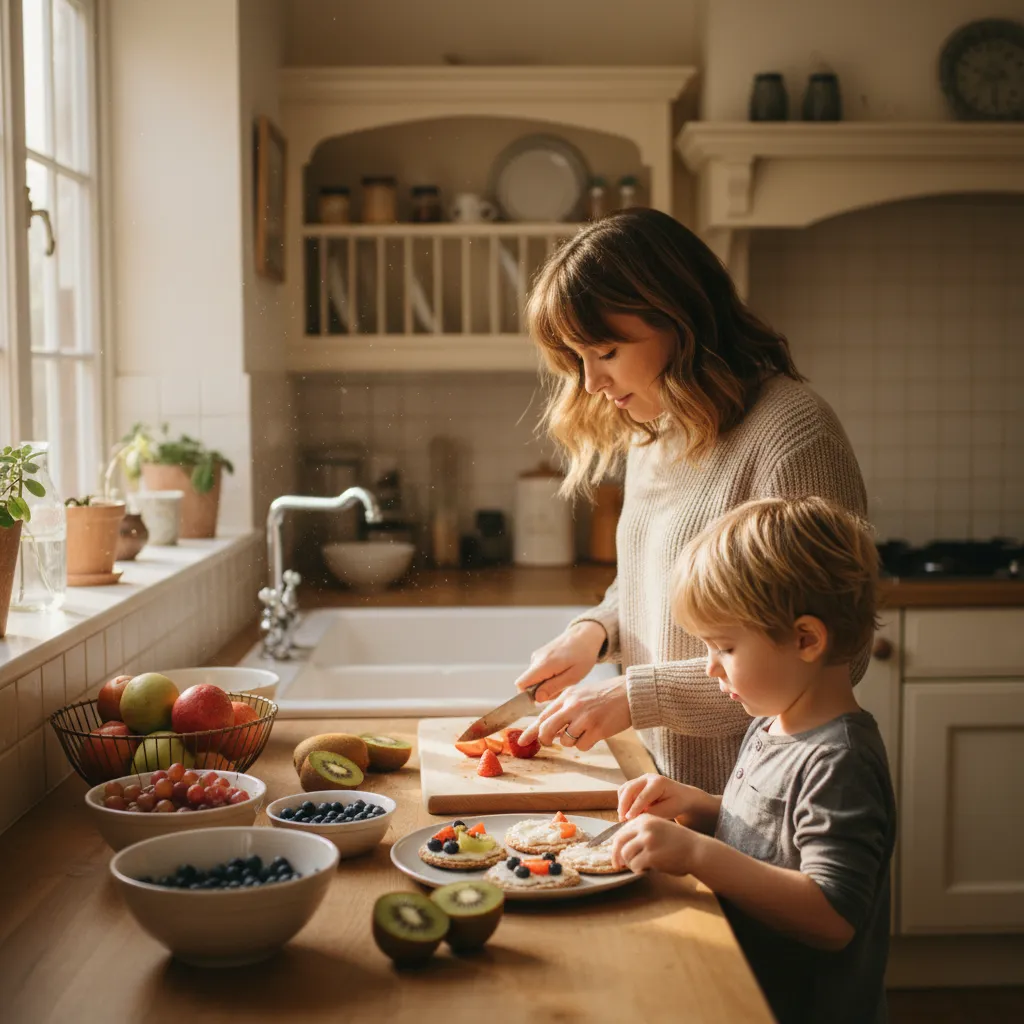
In my clinical practice, I have noticed a clear pattern: children who help prepare their own snacks are far more likely to eat them. This makes intuitive sense. When a child has chosen the ingredients, mixed the batter, or assembled the lunchbox, they feel ownership and pride in what they have made.
Here are some age-appropriate ways to involve your child:
- Ages 3 to 5: Washing fruit, tearing lettuce, stirring yoghurt, and choosing between two healthy options (“Would you like carrot sticks or cucumber sticks today?”)
- Ages 5 to 8: Spreading cream cheese on crackers, threading fruit onto skewers, mashing banana for muffins, and helping to measure ingredients
- Ages 8 to 12: Following a simple recipe independently, operating a blender with supervision, chopping soft foods with an appropriate knife, and packing their own snack box
I recommend setting aside 20 to 30 minutes at the weekend for a family batch-cooking session. Making a tray of oat muffins, a batch of vegetable muffin bites, and a pot of hummus together gives you enough snacks for the school week ahead. It also creates a natural opportunity to talk about food, nutrition and why certain choices help their bodies grow strong.
For families starting the weaning journey with younger siblings, our guide on healthy weaning and introducing solid foods covers how to build positive food habits from the very beginning.
The NHS Change4Life programme also provides free resources, swap suggestions and recipe ideas specifically designed for UK families. Their snack swaps tool is a particularly useful starting point if you want to gradually shift your family’s snacking habits without making dramatic changes overnight.
If your child has recently received an NCMP letter indicating they are above a healthy weight, improving snack choices is one of the most manageable and effective places to begin. Small, consistent changes to snacking often have a larger cumulative impact than attempting to overhaul main meals, which can feel overwhelming for both parents and children.
Understanding what the National Child Measurement Programme measures and why can also help put any concerns into context. It is a screening tool, not a diagnosis, and it is designed to support families rather than alarm them.
Finally, I want to reassure every parent reading this: you do not need to be perfect. Offering a biscuit at a birthday party or letting your child have crisps on a family outing is completely fine. What matters is the overall pattern of eating across the week, not any single snack on any single day. Aim for progress, not perfection, and celebrate the small wins along the way.
Key Points
- Pair a carbohydrate with a protein or healthy fat at every snack to maintain stable energy and concentration
- Batch-prepare snacks at the weekend: oat muffins, vegetable bites and hummus cover most of the school week
- Check your school’s allergy and food policy at the start of each academic year and keep nut-free alternatives to hand
- Use the palm-of-the-hand rule to guide portion sizes for younger children and adjust upwards as they grow
- Involve children in choosing and preparing snacks to increase the likelihood they will eat them
Frequently Asked Questions
How many snacks should a child have per day?
Most children benefit from 2 snacks per day: one mid-morning and one mid-afternoon. Children aged 2 to 4 may need a third smaller snack due to their smaller stomach capacity. The key is to keep snacks appropriately sized so they do not replace main meals. A snack should bridge the gap between meals, not fill your child up so much that they refuse lunch or dinner.
The best healthy snacks children can take to school are those that travel well without refrigeration, are easy to eat quickly during break time, and provide sustained energy. Top options include vegetable sticks with hummus, cheese and wholemeal crackers, oat and banana mini muffins, fruit and cheese skewers, and natural yoghurt tubes frozen the night before. Avoid anything containing nuts unless your school specifically allows them.What are the best healthy snacks children can take to school?
Start by involving your child in the process. Let them choose between two healthy options rather than offering an open-ended choice. Present snacks in fun ways, such as using skewers, cookie cutters for sandwiches, or colourful arrangements on a plate. Pair a new food with something they already enjoy; for example, if they love crackers, add a small piece of cheese alongside. Repeated, pressure-free exposure is the most effective strategy. It can take 10 to 15 exposures before a child accepts a new food, so patience is essential.How can I get my fussy child to eat healthy snacks?
Dried fruits such as apricots, raisins and dates do contain valuable nutrients including iron and fibre. However, the drying process concentrates the natural sugars, making them much higher in sugar per gram than fresh fruit. They also stick to teeth, increasing the risk of tooth decay. I recommend keeping portions small (around 30g per serving) and pairing dried fruit with a protein source like cheese or seeds. Dried fruit counts as one of your child’s five a day, but only one portion per day, regardless of how much is eaten.Are dried fruits a healthy snack for children?
No. Removing snacks entirely can lead to excessive hunger, which often results in overeating at mealtimes or seeking out less healthy options independently. Instead, focus on the quality and portion size of snacks. Choose options that are rich in fibre and protein, such as vegetable sticks with hummus or a small portion of yoghurt with berries. If you are concerned about your child’s weight, speak to your GP or a registered dietitian. Our guide on identifying if your child is overweight can also help you take the first steps.Should I avoid giving my child snacks if they are overweight?
I recommend avoiding snacks that are high in free sugars, heavily processed, or low in nutritional value. This includes chocolate bars, sweets, sugary cereal bars, flavoured crisps, fruit winders, and sugary drinks or squashes. Many of these items contain more than 10g of free sugar per portion, which is over half the recommended daily limit for children aged 4 to 6. Check labels carefully, as some products marketed as “healthy” or “for kids” can be surprisingly high in sugar and low in genuine nutrition.What snacks should I avoid putting in my child’s lunchbox?