
As a paediatric nutritionist who has worked with thousands of families across the NHS and in private practice, I know that asking “is my child overweight?” can feel incredibly daunting. It is one of the most common questions parents bring to my clinic, and it is one I take very seriously. The good news is that understanding your child’s weight status is simpler than you might think, and there are clear, evidence-based steps you can take to support their health.
Key Takeaways
- In England, one in three children leaving primary school are classified as overweight or living with obesity
- BMI in children is assessed using age- and sex-specific centile charts, not the adult BMI categories
- A child above the 91st centile is considered overweight, and above the 98th centile is classified as living with obesity in the UK
- The NHS BMI calculator is free, takes two minutes and gives you an immediate result for children aged 2 to 18
- Visual signs such as outgrowing clothes rapidly, breathlessness during play and persistent fatigue can indicate excess weight
- Early intervention before puberty leads to significantly better long-term outcomes for weight management
In This Article
- Understanding Whether Your Child Is Overweight
- How BMI Works for Children
- Signs Your Child May Be Carrying Excess Weight
- Using the NHS BMI Calculator and Growth Charts
- What the National Child Measurement Programme Tells You
- When to Seek Professional Help
- Practical Steps to Support a Healthy Weight
- Emotional Wellbeing and Body Image
Understanding Whether Your Child Is Overweight
When parents ask me “is my child overweight?”, I always begin by explaining that children’s bodies are supposed to change shape as they grow. Periods of chubbiness are completely normal, particularly in toddlers and just before puberty. However, there is a clear difference between normal developmental changes and a pattern of excess weight gain that could affect your child’s health.
According to the National Child Measurement Programme (NCMP), around 23% of children in Reception (aged 4 to 5) and 35% of children in Year 6 (aged 10 to 11) in England are either overweight or living with obesity. These figures have risen steadily over the past two decades, and they tell us that this is not a rare concern. If you are worried, you are far from alone.
The most important thing I tell parents is this: identifying that your child may be carrying excess weight is not a judgement on your parenting. Weight is influenced by genetics, environment, food availability, activity levels and many other factors. What matters is recognising the situation early so you can take gentle, supportive action. Research published in the BMJ consistently shows that early intervention is far more effective than waiting until excess weight becomes entrenched during adolescence.
I also want to reassure you that the word “overweight” is a clinical term, not a label. In my practice, I use it because it helps families access the right support and resources. Throughout this article, I will walk you through exactly how to assess your child’s weight, what signs to look for, and when it is time to involve your GP or a specialist like me.
How BMI Works for Children
Body Mass Index, or BMI, is the most widely used screening tool for assessing whether a child is a healthy weight. However, children’s BMI works differently from adult BMI, and this is something many parents do not realise.
For adults, BMI is a straightforward number: you divide your weight in kilograms by your height in metres squared, and the result falls into a fixed category. For children, though, the calculation is the same but the interpretation changes with age and sex. A BMI of 18 might be perfectly healthy for a 10-year-old girl but could indicate underweight in a 15-year-old boy. This is why we use centile charts rather than fixed categories.
In the UK, the Royal College of Paediatrics and Child Health (RCPCH) produces the growth reference charts that clinicians use. Your child’s BMI is plotted against data from thousands of children of the same age and sex to determine where they sit on the distribution. You can learn more about how these charts work in our guide to child weight charts and UK centiles.
| UK BMI Centile | Weight Classification | What It Means |
|---|---|---|
| Below 2nd centile | Underweight | Your child weighs less than 98% of children their age and sex |
| 2nd to 91st centile | Healthy weight | Your child’s weight is within the expected range for their age and sex |
| 91st to 98th centile | Overweight | Your child weighs more than 91% of children their age and sex |
| Above 98th centile | Living with obesity | Your child weighs more than 98% of children their age and sex |
It is worth noting that BMI is a screening tool, not a diagnosis. A very muscular or athletic child might have a high BMI without carrying excess body fat. Similarly, a child with a BMI in the healthy range could still have concerning body composition. This is why I always recommend using BMI alongside other observations, which I will cover in the next section. For a step-by-step guide to checking your child’s BMI at home, see our BMI calculator for children page.
Signs Your Child May Be Carrying Excess Weight
While BMI gives you a number, there are also practical, everyday signs that can indicate your child may be carrying more weight than is healthy. In my clinic, I encourage parents to observe their children holistically rather than focusing solely on scales.
Physical signs to watch for include:
- Clothes becoming tight around the waist or thighs faster than expected for their growth stage
- Visible skin folds or chafing, particularly around the inner thighs, underarms or neck
- Breathlessness during moderate physical activity such as walking uphill, playing in the garden or climbing stairs
- Snoring or disrupted sleep, which can be associated with excess weight around the neck and airways
- Stretch marks appearing on the abdomen, hips or upper arms
- Acanthosis nigricans: darkened, velvety patches of skin around the neck or armpits, which can signal insulin resistance
Behavioural and lifestyle signs can also be revealing:
- Your child avoids physical activity or PE lessons and prefers sedentary pastimes
- They eat large portions regularly or frequently ask for second helpings
- They consume sugary drinks, crisps or sweets daily rather than as occasional treats
- Screen time consistently exceeds two hours per day outside of schoolwork
- They eat quickly, often finishing meals well before everyone else at the table
- They seem to eat in response to boredom, stress or tiredness rather than hunger
I want to emphasise that none of these signs on their own confirms that your child is overweight. Children go through growth spurts, appetite surges and phases of lower activity that are completely normal. What you are looking for is a persistent pattern over weeks and months. If several of these signs resonate with what you are seeing at home, it is worth checking your child’s BMI and speaking to a health professional.
Using the NHS BMI Calculator and Growth Charts
The simplest way to check whether your child is overweight is to use the NHS BMI calculator for children and teenagers. It is free, takes about two minutes, and you can do it at home with just a tape measure and bathroom scales.
Here is exactly what you need to do:
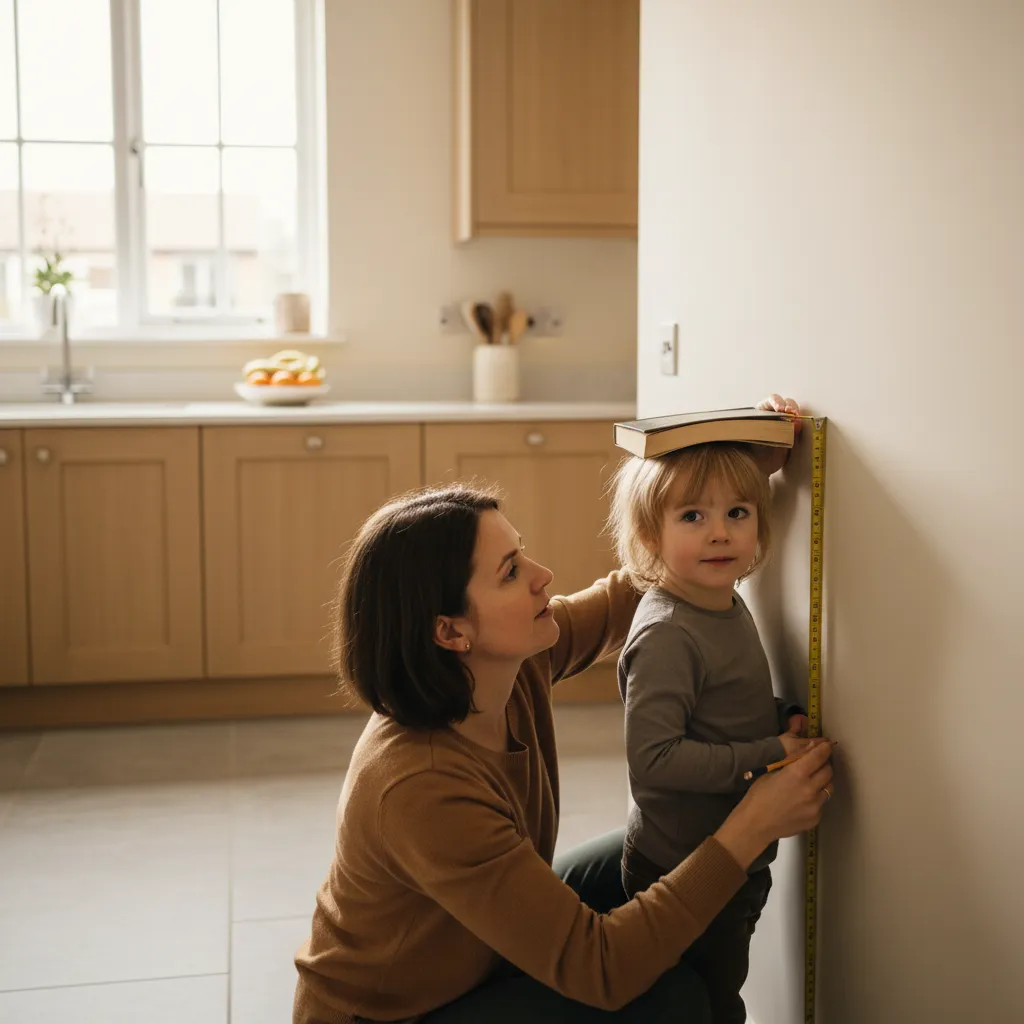
- Measure your child’s height without shoes. Have them stand against a wall with their heels, bottom and shoulders touching it. Place a flat object like a hardback book on top of their head, parallel to the floor, and mark the wall. Measure from the floor to the mark in centimetres.
- Weigh your child in light indoor clothing, without shoes, at a consistent time of day. Morning before breakfast tends to give the most reliable reading. Record the weight in kilograms.
- Enter the details into the NHS calculator along with your child’s date of birth and sex.
- Review the result, which will show your child’s BMI centile and what it means.
The NHS calculator is designed for children aged 2 to 18 years. For children under 2, your health visitor will use specific length-for-age and weight-for-age charts in the Personal Child Health Record (the “red book”). If your child is under 2 and you have concerns, your health visitor is the best first point of contact.
Growth charts are particularly useful because they show trends over time. A single measurement tells you where your child sits at one moment, but tracking their BMI at regular intervals reveals whether they are moving upward through the centiles, staying stable, or dropping. I recommend parents check their child’s BMI at home at least once or twice a year and note down the results. If you see a consistent upward trend crossing centile lines, that is a more reliable indicator than any single reading.
For a more detailed explanation of how to interpret centile charts and what different centile positions mean, I recommend reading our comprehensive guide on understanding UK centiles and percentiles.
What the National Child Measurement Programme Tells You
If your child attends a state school in England, they will be weighed and measured as part of the National Child Measurement Programme (NCMP). This happens twice during their school years: once in Reception (aged 4 to 5) and once in Year 6 (aged 10 to 11). The programme is run by local authority public health teams and has been operating since 2006.
After the measurements are taken, you will receive a letter with your child’s results. The letter will tell you which weight category your child falls into and provide advice on next steps. Many parents find this letter alarming, particularly if it indicates their child is above a healthy weight. I have supported many families through this moment, and I always say: this letter is information, not a verdict.
The NCMP data is incredibly valuable. It allows public health teams to monitor childhood obesity trends at a population level, and it gives you a clinical snapshot of your child’s weight status at two key developmental stages. However, it has limitations. Two measurements across an entire primary school career cannot capture the full picture. That is why I encourage parents to supplement NCMP results with their own regular checks at home.
You can learn much more about how the programme works, what the results mean, and how to respond to the letter in our detailed article on the National Child Measurement Programme.
If your child’s NCMP result indicates they are overweight or living with obesity, your local authority may offer access to free family healthy weight programmes. These are group-based programmes that focus on nutrition education, physical activity and behaviour change. I have seen families benefit enormously from these programmes, and I strongly encourage you to take up the offer if it is available in your area.
When to Seek Professional Help
One of the questions I hear most often is: “When should I actually see someone about my child’s weight?” Here is my honest, practical advice based on over 15 years of clinical experience.
You should speak to your GP or practice nurse if:
- Your child’s BMI is consistently above the 91st centile on the UK growth charts
- Their BMI has crossed upward through two or more centile lines over six to twelve months
- They are experiencing physical symptoms such as joint pain, breathlessness during normal activity, snoring, or skin changes like acanthosis nigricans
- They are showing signs of emotional distress related to their weight, including being bullied, withdrawing from activities, or expressing hatred of their body
- There is a family history of type 2 diabetes, cardiovascular disease or obesity-related conditions
- You have tried making changes at home for three months or more without seeing any improvement
Your GP can carry out a more thorough assessment. In some cases, they may check for underlying medical conditions that contribute to weight gain, though these are relatively rare. Conditions such as hypothyroidism, Cushing’s syndrome and certain genetic conditions can cause excess weight gain, and your GP can arrange blood tests if they suspect these. According to NICE guidelines (CG189), children identified as overweight or living with obesity should be offered tailored lifestyle interventions as the first line of treatment.
I also want to mention that you do not need to wait for a crisis to seek help. If you are simply unsure whether your child’s weight is something to worry about, a quick conversation with your GP, health visitor or school nurse can provide reassurance or early guidance. The earlier concerns are addressed, the easier and more effective interventions tend to be.
Referral to a paediatric dietitian or nutritionist (like me) may be appropriate if your child needs a structured, individualised eating plan or if there are complex factors involved such as food allergies, fussy eating, or an underlying health condition. Your GP can make this referral through the NHS, or you can seek a private consultation.
Practical Steps to Support a Healthy Weight
If you have established that your child is carrying excess weight, or if you want to prevent weight problems before they develop, there are practical, evidence-based steps you can take at home. I always tell families that small, consistent changes are far more sustainable than dramatic overhauls.
Nutrition
Focus on what you add, not what you remove. Rather than banning foods (which tends to make them more appealing), concentrate on increasing the variety and quantity of nutritious foods in your child’s diet.
- Aim for five portions of fruit and vegetables every day. Start by adding one extra portion at a meal where they currently have none.
- Swap sugary drinks for water, milk or sugar-free squash. Sugary drinks are the single largest source of added sugar in children’s diets in the UK.
- Serve appropriate portion sizes. A useful rule of thumb for younger children is that a portion of carbohydrate should be roughly the size of their fist.
- Eat meals together as a family whenever possible. Research from the University of Leeds found that children who eat regular family meals have healthier diets and lower rates of obesity.
- Limit takeaways and ultra-processed foods to once a week or less. These foods tend to be calorie-dense but nutrient-poor.
- Include protein at every meal (eggs, beans, fish, lean meat, dairy) as it helps children feel satisfied for longer.
Physical Activity
The UK Chief Medical Officers recommend that children aged 5 to 18 should be active for at least 60 minutes every day, at moderate to vigorous intensity. For younger children aged 1 to 4, the recommendation is at least 180 minutes of activity spread throughout the day, with some of it being energetic play.
- Make activity a family habit. Walk to school, cycle at weekends, visit the park after dinner.
- Reduce sedentary screen time. The UK Chief Medical Officers’ guidelines recommend breaking up long periods of sitting.
- Find an activity your child genuinely enjoys. It does not have to be competitive sport; dancing, swimming, scooting, trampolining and even active play all count.
- Be a role model. Children who see their parents being active are significantly more likely to be active themselves.
Sleep and Routine
Sleep is an often-overlooked factor in childhood weight. Studies published in the International Journal of Obesity have consistently shown that children who sleep less than the recommended amount are at higher risk of excess weight gain. The NHS recommends the following sleep durations:
| Age Group | Recommended Sleep (hours per night) |
|---|---|
| 1 to 2 years | 11 to 14 hours (including naps) |
| 3 to 5 years | 10 to 13 hours (including naps) |
| 6 to 12 years | 9 to 12 hours |
| 13 to 18 years | 8 to 10 hours |
Establishing a consistent bedtime routine, removing screens from bedrooms, and ensuring the bedroom is cool and dark can all improve sleep quality and, in turn, support a healthier weight.
Emotional Wellbeing and Body Image
This is the section I feel most strongly about as a clinician. How we talk to children about weight matters enormously. Weight stigma causes real, measurable harm, and I have seen it first-hand in my practice. Children who feel shamed about their bodies are more likely to develop disordered eating patterns, avoid physical activity, and experience anxiety and depression.
Here is how I recommend approaching the topic with your child:
- Never use the word “fat” or “diet” when talking to or about your child. Use neutral language like “growing healthily” or “looking after our bodies”.
- Focus on health behaviours, not weight. Talk about eating well and being active because it makes us feel good, gives us energy, and helps us concentrate at school.
- Avoid commenting on your own or other people’s bodies negatively. Children absorb these messages and internalise them.
- Praise effort and enjoyment in physical activity rather than performance or appearance.
- If your child is being bullied about their weight, take it seriously. Speak to their school, and consider whether they would benefit from talking to a counsellor.
I have worked with many children who were put on restrictive diets by well-meaning parents, and in almost every case it made the situation worse. Restrictive dieting in childhood is associated with increased weight gain over time, binge eating, and a damaged relationship with food. The goal for most overweight children is not weight loss but rather weight maintenance as they grow taller, allowing them to naturally “grow into” their weight.
If you suspect your child is struggling emotionally with their weight or developing an unhealthy relationship with food, speak to your GP about a referral to a child psychologist or the local Child and Adolescent Mental Health Services (CAMHS). The NHS advice page for parents of overweight children also provides helpful guidance on having sensitive conversations.
Our articles on using a BMI calculator and understanding centile charts can help you monitor your child’s progress in a factual, non-judgemental way that focuses on health rather than appearance.
Key Points
- Use the NHS BMI calculator to check your child’s weight status at least once or twice a year
- Look for persistent patterns of physical and behavioural signs rather than focusing on any single indicator
- Speak to your GP if your child’s BMI is above the 91st centile or if it is rising steadily through the centile bands
- Focus on adding nutritious foods and enjoyable physical activity rather than restricting or removing foods
- Protect your child’s emotional wellbeing by using positive, health-focused language and never shaming them about their weight
Frequently Asked Questions
How can I tell if my child is overweight without using scales?
While scales and the BMI calculator give you the most accurate assessment, there are observational signs you can look for. If your child becomes breathless during moderate activity like walking uphill, if their clothes are consistently tight around the waist despite being the right age size, or if they have visible skin folds or chafing, these can indicate excess weight. However, I always recommend confirming your observations with a BMI check using the free NHS children’s BMI calculator, as visual estimation alone is unreliable. Research shows that parents correctly identify their child’s weight status only about 50% of the time by eye alone.
It is never too early to establish healthy habits, but clinical concern about excess weight typically begins from around age 2, which is when the NHS BMI calculator becomes usable. Before age 2, your health visitor monitors growth using specific infant charts in the red book. If your child is above the 91st centile at their Reception year NCMP measurement (age 4 to 5), that is a good time to start making supportive changes. The earlier you act, the more effective and gentle the interventions can be. I would encourage any parent with concerns to speak to their health visitor or GP regardless of their child’s age.At what age should I start worrying about my child’s weight?
BMI can sometimes overestimate body fat in children who are very muscular or have a particularly athletic build. However, this is relatively uncommon in young children and is more likely to be a factor in teenagers who are involved in strength-based sports such as gymnastics, rugby or swimming. If your child is highly active and muscular, and their BMI comes back above the 91st centile, I would recommend seeing your GP for a more comprehensive assessment. They can consider factors like waist circumference, skin-fold measurements, and your child’s overall health profile alongside the BMI reading.Is BMI accurate for very active or muscular children?
No, I do not recommend putting children on restrictive diets. The evidence is clear that calorie-restricted diets in childhood can lead to nutritional deficiencies, disordered eating, and paradoxically, increased weight gain over time. Instead, the recommended approach for most overweight children is to improve the overall quality of the family’s diet and increase physical activity, with the goal of weight maintenance rather than weight loss. As your child grows taller, their BMI will naturally reduce if their weight remains stable. Make changes for the whole family rather than singling out the overweight child, and focus on adding nutritious foods rather than eliminating treats entirely.Should I put my overweight child on a diet?
First, try not to panic. The NCMP letter provides a clinical snapshot at one point in time and is meant to be informative, not alarming. I recommend re-checking your child’s BMI at home using the NHS calculator to confirm the result. If the result is consistent, make an appointment with your GP or practice nurse to discuss it. Your local authority may also offer free family healthy weight programmes that provide practical support with nutrition and activity. You can read our full guide on the National Child Measurement Programme for detailed advice on understanding and responding to the letter.What should I do if my child’s NCMP letter says they are overweight?
This is a nuanced question. In the short term, a child who is slightly above the 91st centile may appear perfectly healthy and have normal blood pressure, blood sugar and cholesterol levels. However, the NICE guidelines are clear that excess weight in childhood significantly increases the risk of developing type 2 diabetes, cardiovascular disease, joint problems and mental health difficulties both in childhood and later in adult life. Around 80% of children living with obesity will continue to live with obesity as adults. So while your child may feel fine now, taking steps to support a healthy weight is an investment in their long-term health.Can my child be overweight and still be healthy?