Key Takeaways
- The National Child Measurement Programme measures children in Reception (age 4–5) and Year 6 (age 10–11) in state-funded schools across England every year
- In the most recent data, approximately 1 in 5 Reception children and 1 in 3 Year 6 children were classified as overweight or living with obesity
- Children are weighed and measured by trained school nursing teams, and the process takes just a few minutes per child
- Parents and carers receive a confidential feedback letter explaining their child’s weight category and offering support if needed
- The NCMP has been running since 2006 and is one of the largest child health surveillance programmes in the world
- You can opt your child out of the programme, though health professionals encourage participation to support public health planning
In This Article
- What Is the National Child Measurement Programme?
- Why the NCMP Matters for Your Child’s Health
- How Are Children Measured?
- Understanding Your Child’s NCMP Results
- NCMP Weight Categories Explained
- What the Results Mean for Your Family
- NCMP Data and Trends in England
- Opting Out, Privacy and Data Protection
- How to Support Your Child After the NCMP
What Is the National Child Measurement Programme?
As a paediatric nutritionist who has worked across the NHS for over 15 years, I often find that parents have heard of the National Child Measurement Programme but are not entirely sure what it involves or why it exists. Let me walk you through everything you need to know.
The National Child Measurement Programme (NCMP) is an annual public health initiative run by the Office for Health Improvement and Disparities (OHID), formerly Public Health England, in partnership with NHS England. Every school year, trained health professionals visit state-funded primary schools across England to measure the height and weight of children in two specific year groups: Reception (ages 4 to 5) and Year 6 (ages 10 to 11).
The programme was established in 2006 and has since become one of the most comprehensive child health surveillance systems in the world. Each year, over one million children are measured, providing invaluable data on childhood weight trends at both a local and national level. The data gathered helps local authorities, the NHS and the government to plan services, allocate resources and develop strategies to tackle childhood obesity across England.
Why the NCMP Matters for Your Child’s Health
I understand that some parents feel anxious when they hear their child will be weighed at school. It is completely natural to have questions or concerns. However, in my clinical experience, the NCMP serves several vital purposes that benefit both individual families and the wider community.
Firstly, the programme provides an early health check for your child. Weight issues in childhood can develop gradually, and it is not always easy to notice changes when you see your child every day. The NCMP acts as a helpful prompt, giving you objective information about your child’s growth at two key stages of development.
Secondly, the data collected feeds directly into public health planning. Local councils use NCMP results to understand the health needs of children in their area and to commission appropriate services, such as healthy eating programmes, physical activity initiatives and family support services. Without this data, it would be far more difficult to target resources where they are needed most.
Thirdly, the NCMP helps researchers and policymakers track long-term trends in childhood obesity. This evidence base is crucial for evaluating whether public health interventions are working and for shaping future policy. The programme has been instrumental in highlighting the widening health inequalities between children from the most and least deprived areas of England.
From my perspective as a clinician, the NCMP is not about labelling children or causing worry. It is about providing families with useful health information and ensuring that every child has the opportunity to grow up at a healthy weight.
How Are Children Measured?
Parents often ask me what the measurement process actually looks like. I can reassure you that it is quick, simple and designed to be as comfortable as possible for children.
Here is what happens on measurement day:
- Trained school nurses or healthcare assistants visit the school to carry out the measurements
- Children are measured in a private area, usually away from classmates, to protect their dignity
- They are asked to remove their shoes and any heavy clothing such as coats or jumpers
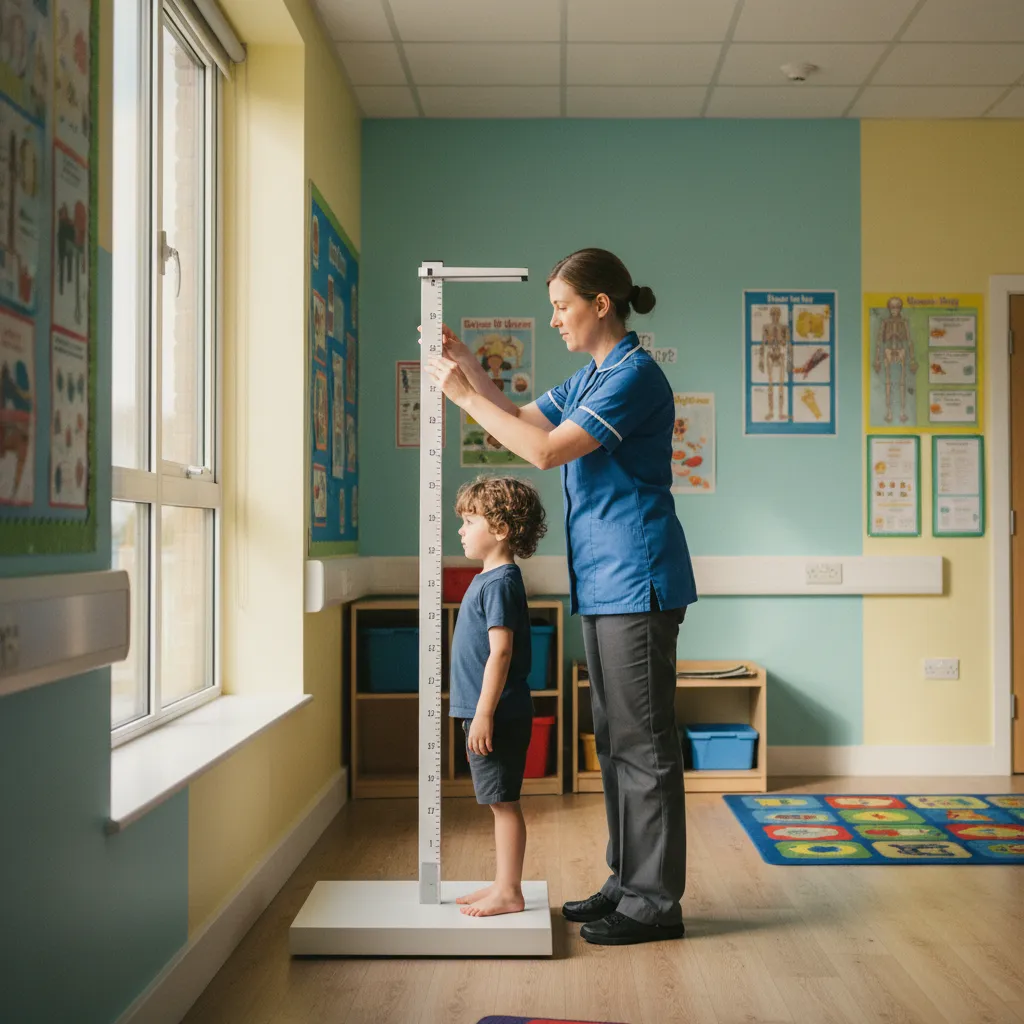
- Their height is measured using a portable stadiometer (a calibrated height measure)
- Their weight is recorded on calibrated digital scales
- The entire process takes approximately two to three minutes per child
- Children are not told their results on the day, and measurements are kept confidential
It is important to note that children are measured individually, not in front of their peers. The health team takes great care to ensure the experience is positive and that children feel at ease. In my experience, most children barely think twice about it.
Schools are required to inform parents in advance that the NCMP measurements will be taking place, usually through a letter or notification sent home. This gives you the opportunity to discuss the process with your child or to opt out if you wish.
Understanding Your Child’s NCMP Results
After the measurements are taken, your child’s height and weight are used to calculate their body mass index (BMI). However, unlike adult BMI, children’s BMI is interpreted differently. Because children’s body composition changes as they grow, their BMI is plotted on age- and sex-specific growth charts, known as centile charts.
The NCMP uses the British 1990 (UK90) growth reference to determine which centile your child falls on. This tells you how your child’s BMI compares with other children of the same age and sex. For example, if your child is on the 75th centile, it means their BMI is higher than 75% of children their age.

You will receive a confidential feedback letter from your local authority, usually within a few weeks of the measurement. This letter will tell you your child’s weight category and provide information about local support services if appropriate. The letter is addressed to parents and carers only; it is not shared with the school, teachers or other parents.
If you would like to check your child’s BMI at any time, you can use the NHS BMI calculator for children, which uses the same UK90 growth reference as the NCMP.
NCMP Weight Categories Explained
The NCMP classifies children into four weight categories based on their BMI centile. Understanding these categories can help you make sense of your child’s results.
| Weight Category | BMI Centile Range | What It Means |
|---|---|---|
| Underweight | Below the 2nd centile | Your child’s BMI is lower than 98% of children their age. Further assessment may be recommended. |
| Healthy weight | 2nd to 84th centile | Your child’s BMI falls within the expected range for their age and sex. |
| Overweight | 85th to 94th centile | Your child’s BMI is higher than most children their age. Small lifestyle changes may help. |
| Living with obesity | 95th centile or above | Your child’s BMI is significantly above the expected range. Support and guidance are available. |
It is worth noting that the NCMP also uses a subcategory of severe obesity for children at or above the 99.6th centile. This category is used primarily for public health monitoring and planning rather than in the feedback letters sent to parents.
I want to emphasise that these categories are screening tools, not diagnoses. BMI does not distinguish between muscle and fat, and there are many factors that influence a child’s weight. If you have any concerns about your child’s results, I always recommend speaking with your GP or school nurse, who can carry out a more thorough assessment.
What the Results Mean for Your Family
Receiving your child’s NCMP results can bring up a range of emotions. Some parents feel relieved, while others may feel surprised or worried. Whatever your reaction, please know that the purpose of the programme is to inform, not to judge.
If your child is in the healthy weight category, that is wonderful news. It suggests that their current lifestyle is supporting healthy growth. Keep doing what you are doing, and continue to encourage a balanced diet and regular physical activity.
If your child is classified as overweight or living with obesity, try not to panic. This result is a starting point for understanding your child’s health, not a verdict. In my practice, I have worked with hundreds of families in this situation, and I know that small, sustainable changes can make a significant difference over time. Your local authority may offer free support programmes, and your GP or practice nurse can provide personalised advice.
If your child is classified as underweight, it is also important to seek guidance. Being underweight can sometimes indicate nutritional deficiencies or underlying health conditions that benefit from early intervention. Your GP can help rule out any medical causes and refer you to a dietitian if needed.
Whatever the result, I would encourage you to avoid discussing weight in terms of “good” or “bad” with your child. Instead, focus on healthy behaviours: enjoying a variety of foods, being physically active, getting enough sleep and looking after mental wellbeing. Children pick up on the language we use, and a positive approach makes a real difference.

NCMP Data and Trends in England
The NCMP has now been collecting data for nearly two decades, giving us a detailed picture of how childhood weight has changed over time. As someone who follows this data closely, I find the trends both informative and sobering.
Before the COVID-19 pandemic, childhood obesity rates in England had been relatively stable, though persistently high. The pandemic, however, caused a significant increase in obesity prevalence, particularly among younger children and those from the most deprived backgrounds.
| Year Group | Overweight or Obese (Pre-Pandemic 2018/19) | Overweight or Obese (Peak 2020/21) | Most Recent Trends |
|---|---|---|---|
| Reception (age 4–5) | 22.6% | 27.7% | Rates have begun to decrease but remain above pre-pandemic levels |
| Year 6 (age 10–11) | 34.3% | 40.9% | Gradual decline observed, though still elevated compared to 2018/19 |
One of the most striking findings from the NCMP is the inequality gap. Children living in the most deprived areas of England are more than twice as likely to be living with obesity compared to children in the least deprived areas. This gap widened further during the pandemic and has yet to fully recover. Addressing this inequality remains one of the greatest challenges in children’s public health.
The NCMP data has been pivotal in shaping government policy, including the Childhood Obesity Plan and initiatives such as the Soft Drinks Industry Levy (the sugar tax), restrictions on advertising of foods high in fat, sugar and salt, and calorie labelling in restaurants.
Opting Out, Privacy and Data Protection
A question I hear frequently from parents is whether they can opt their child out of the NCMP. The answer is yes. The NCMP operates on an opt-out basis, meaning your child will be measured unless you specifically request otherwise.
If you wish to opt out, you should contact your child’s school or the local authority’s school nursing team before the measurement day. Most schools will include information about how to opt out in the notification letter they send home.
While I respect every parent’s right to make this choice, I would gently encourage participation where possible. The measurement is quick, non-invasive and provides valuable information about your child’s health. It also contributes to the wider dataset that helps plan and improve health services for all children in your area.
Regarding data protection, the NCMP takes privacy very seriously. Your child’s individual results are treated as confidential medical information and are subject to strict data protection regulations. The data is shared with your local authority for the purpose of providing feedback and commissioning services. At a national level, the data is anonymised before being used for statistical analysis and research.
Your child’s results are not shared with teachers, classmates or other parents. Only you and the relevant health professionals involved in the programme will have access to your child’s individual measurements. For further details on how your data is handled, you can visit the NHS England Digital NCMP page.
How to Support Your Child After the NCMP
Regardless of your child’s results, the NCMP can be a useful prompt to reflect on your family’s health habits. Here are some practical steps I recommend to families in my practice.
For all families:
- Aim for at least 5 portions of fruit and vegetables a day, and try to include variety
- Encourage 60 minutes of physical activity every day, which can include active play, walking, cycling or organised sports
- Limit screen time and encourage outdoor activities where possible
- Establish regular meal and snack times rather than constant grazing
- Eat together as a family whenever you can; shared mealtimes support healthy eating habits
- Ensure your child gets adequate sleep, as poor sleep is linked to weight gain in children
If your child has been identified as overweight or living with obesity:
- Speak to your GP or school nurse for personalised advice and to discuss any concerns
- Ask about local family healthy weight programmes; many local authorities offer free support
- Focus on the whole family’s lifestyle rather than singling out your child; changes work best when everyone is involved
- Avoid putting your child on a restrictive diet; growing children need a wide range of nutrients
- Use the BMI calculator for children to track progress over time
If your child has been identified as underweight:
- Book an appointment with your GP to rule out any underlying health conditions
- Ask for a referral to a paediatric dietitian if needed
- Focus on nutrient-dense foods that provide energy and essential vitamins and minerals
- Monitor your child’s growth using UK centile charts to ensure they are gaining weight appropriately
Remember, the NCMP is just one piece of the puzzle when it comes to your child’s health. It provides a snapshot in time, and children’s growth patterns can vary widely. If you have concerns at any point during the year, do not wait for the next round of school measurements. Speak to your GP, health visitor or school nurse. The NHS website also has a wealth of information and resources to support families.
In my years of working with families, I have seen time and again that knowledge is empowering. Understanding your child’s growth and having access to the right support can make a genuine difference. The NCMP is there to help, and I would encourage every family to engage with the process and use the results as a positive tool for their child’s wellbeing.
Key Points
- Check if your child is due to be measured this year (Reception or Year 6) and discuss the process with them beforehand
- Read the confidential feedback letter carefully when it arrives and note your child’s weight category
- Use the NHS BMI calculator for children to monitor your child’s growth between NCMP measurements
- Contact your GP or school nurse if you have any concerns about your child’s weight, whether overweight or underweight
- Focus on whole-family healthy habits rather than singling out any one child; aim for 5-a-day, 60 minutes of activity and regular mealtimes
Frequently Asked Questions
What age groups are included in the National Child Measurement Programme?
The NCMP measures children in Reception (ages 4 to 5) and Year 6 (ages 10 to 11) in state-funded schools across England. These two age groups were chosen because they represent key stages of childhood development, allowing health professionals to monitor growth trends at the start and end of primary school.
Yes, you can opt your child out. The programme operates on an opt-out basis, so you need to contact your child’s school or the local school nursing team before measurement day. While opting out is your right, health professionals encourage participation as it provides valuable health information for your child and contributes to public health planning in your area.Can I opt my child out of the NCMP?
No. Children are not told their results on the day of the measurement. The results are sent directly to parents and carers in a confidential letter from the local authority. Teachers, classmates and other parents do not have access to your child’s individual measurements.Will my child be told their weight at school?
Try not to worry. The NCMP result is a screening tool, not a diagnosis. I recommend speaking with your GP or school nurse for personalised advice. Many local authorities offer free family healthy weight programmes. Focus on positive lifestyle changes for the whole family, such as eating more fruit and vegetables, being more active together and reducing sugary drinks, rather than putting your child on a restrictive diet.What should I do if my child’s results show they are overweight?
While the BMI formula is the same (weight in kg divided by height in metres squared), the way it is interpreted differs significantly. Children’s BMI is plotted on age- and sex-specific centile charts using the British 1990 (UK90) growth reference. This accounts for the fact that children’s body composition changes naturally as they grow. A BMI that would be healthy for a 5-year-old may be very different from what is healthy for an 11-year-old. You can learn more about how children’s BMI is calculated on our dedicated page.How is children’s BMI different from adult BMI?
Yes, the NCMP as a formal programme operates in England only. However, Scotland, Wales and Northern Ireland have their own child health surveillance programmes that monitor children’s growth and weight. In Wales, for example, the Child Measurement Programme is run by Public Health Wales and measures children at a similar age. If you live outside England, contact your local health board for information about equivalent programmes in your area.Is the NCMP only for children in England?
The latest NCMP data is published annually by NHS England Digital and is freely available on the NHS Digital website. You can also find summary reports and policy documents on the GOV.UK website. These resources provide breakdowns by region, deprivation level, ethnicity and gender.Where can I find the latest NCMP data and statistics?